Blog icon

December 2025

Notes from the ATNF leadership team

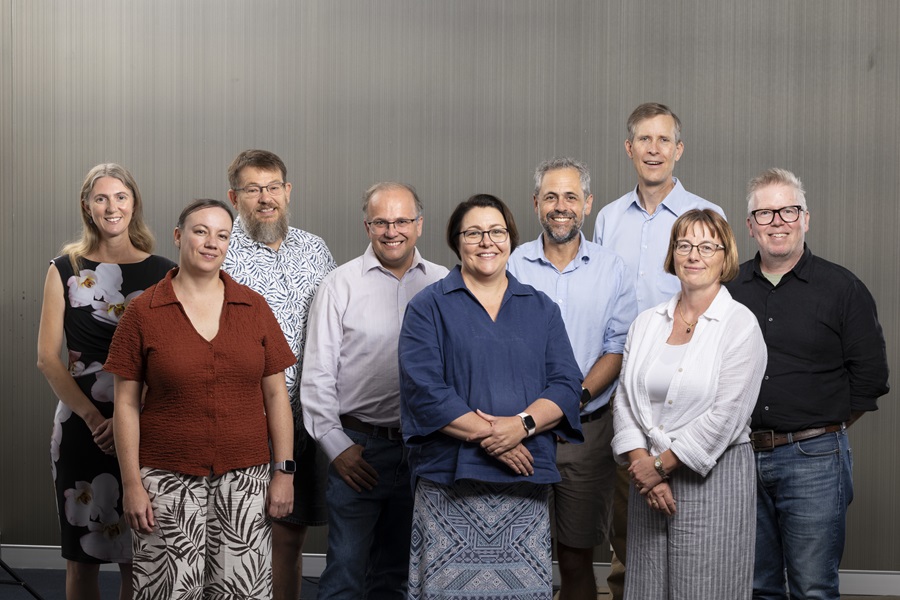
Nine people stand together, smiling towards the viewer
The CSIRO ATNF leadership team

Welcome to our last newsletter from 2025. Rather than hearing just from me, I invite the ATNF leadership team to offer their updates. The new leadership structure implementation was a highlight this year, with the team working together on the priorities, actions and goals set by the Australia Telescope User Committee, Steering Committee and CSIRO.

I would like to congratulate the whole ATNF team and user community for an excellent year. Today we published our Annual Report for 2024-2025, which offers a snapshot of our work across facility operations, scientific research, engineering, data management and community engagement.

Happy holidays and all the best as we head towards the New Year.

– Douglas Bock, ATNF Director 

Since I joined the ATNF team at the beginning of the year, I have seen firsthand how our exceptionally dedicated staff works tirelessly to maintain and enhance our radio astronomy facilities and instruments. Our common aim is to provide reliable observation opportunities and data products to advance your research.

This newsletter captures some of our updates and is a chance to remind you that calls for proposals are open, including observations with the new, revolutionary CRACO instrument, and shared risk observing on ATCA with the new BIGCAT system.

– Celine D’Orgeville, ATNF Program Director

I enjoyed reading in this newsletter about Dr Barnali Das’ experience as one of the first researchers to use the new BIGCAT system. The science that will come from this system is truly exciting and I look forward to seeing these highlights in the newsletter, our annual reports, and online on our news page.

We have updated some of the communications channels for ASKAP surveys, including new ATNF liaisons for each team to enable more efficient flow of information, and providing weekly updates on plans and outcomes to the team Principal Investigators. We are discussing whether a specific ASKAP newsletter, as had previously existed, may be a valuable edition. Stay tuned.

– Cathryn Trott, ATNF Chief Scientist

We’ve got marvellous science highlights in this edition that are only two examples of a wealth of research I know is being produced by our user community. I look forward to seeing what boundaries of scientific knowledge will be addressed in the next round of proposals.

It’s great to see that ASKAP has been progressing the Survey Science Programs in line with its timeline. We are working towards completing the FLASH neutral hydrogen absorption survey by March 2026, and are also excited to have started observing for the GASKAP-HI survey that is studying star-forming gas in our own Galaxy.

– George Hobbs, ATNF Head of Science
Science highlight

Image: screenshot of search results

Galactic search engine

Machine learning and artificial intelligence can help classify different types of radio sources into categories, something that would take too long to do by eye. One such tool is the EMU Search Engine (EMUSE), developed to identify galaxies with rare or complex shapes without manually browsing millions of source images. EMUSE contains corresponding images from ASKAP and the WISE space telescope.

Learnings from ATCA Science Day

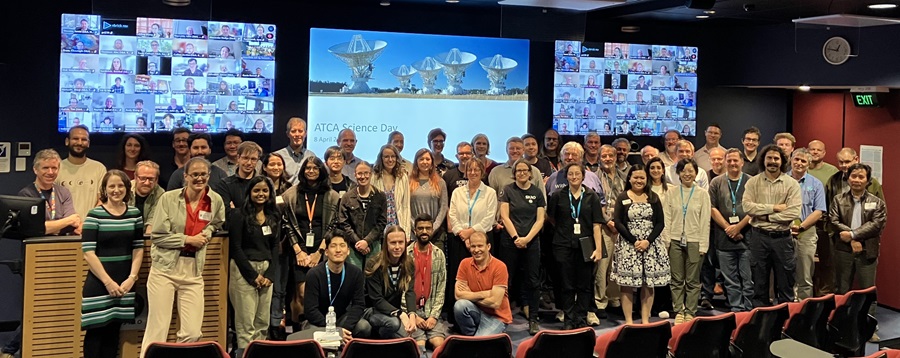
A large group of people gather in a lecture theatre with screens behind showing even more people and an image of a telescope.
Participants of the 2025 ATCA Science Day

In April, the ATCA Science Day was held in Marsfield and online. It was very well-attended, with active participation from the community and a lot of discussion on ATCA science and addressing future funding challenges.

The community is excited about the science capabilities of recent upgrades, including the flexibility and agility enabled by the new BIGCAT correlator. 

There was a lot of discussion and enthusiasm for exploring future capabilities for transient science, including maximising spectral bandwidth and using sub-array modes for flexibility in how observations are undertaken. 

The role of ATCA as the sensitivity core of the LBA was highlighted, with some discussion about the flexibility enabled by BIGCAT for VLBI scheduling. 

Beyond the science with ATCA that the community is excited about, there was discussion about the overall funding challenges with its operations, and ATNF invited the community to channel their science enthusiasm into supporting the pursuit of avenues for future funding, including through domestic funding opportunities, and partnerships with international observatories. 

In February, we will host a similar day for considering the ATNF of the future, particularly at Inyarrimanha Ilgari Bundara, our Murchison Radio-astronomy Observatory. More information is available on our website events listing. 
BIGCAT commissioning

This week, we achieved the full 8 GHz bandwidth with the new BIGCAT system, and observing with the new wideband will start later this month. This is a huge achievement, making ATCA one of the only telescopes in this world with such a wide instantaneous bandwidth. 

Former Bolton Fellow, Dr Barnali Das was one of the first people to observe in our early science commissioning stage after the initial installation of the new correlator. We asked her to share her experience of the process:

"BIGCAT is the new GPU-based correlator for ATCA that will eventually provide ~8 GHz of instantaneous bandwidth. No arrays in the southern hemisphere currently have that capacity at mid-frequencies.

After finishing the engineering commissioning, the science commissioning began in August. I am really excited to be a part of the science commissioning team. Along with several others from CSIRO and other organisations, I was commissioning the continuum mode of observation as well as examining polarisation data products.

Chandra Murugesham and Josh Preston Pritchard helped me to prepare my first schedule file. Even then, there was a bug that was quickly fixed by Jamie Stevens. Christoph Brem walked me through the steps on how to remotely operate the telescope and also how to end the observation.

On the second day of the commissioning week, I had the opportunity to observe a pair of special radio stars that belong to the class of main-sequence radio pulse emitters (MRPs) at 9 GHz.

I received the data as soon as the observation finished! Copying the data was quite easy, thanks to the detailed instructions from the BIGCAT core team. I was delighted to find that the twin MRPs were detected at high significance and at their correct locations.

We did find a number of issues, most of them were fixed quickly by the BIGCAT team. Overall, it has been a great experience and I am looking forward to using BIGCAT at its full glory for doing stellar science."

More updates on the status of BIGCAT are available on our website.

Science highlight

Image: installation at the observatory

All-sky measurements

A new high-precision, broadband measurement of the low-frequency radio sky brightness reveals a 17% difference compared to existing models, which have relied on data dating back to the 1960s. This result will improve astrophysical models and enable the calibration of radio telescopes operating at these frequencies, such as the SKA Observatory’s SKA-Low telescope in Australia.

Meet our new executive officers

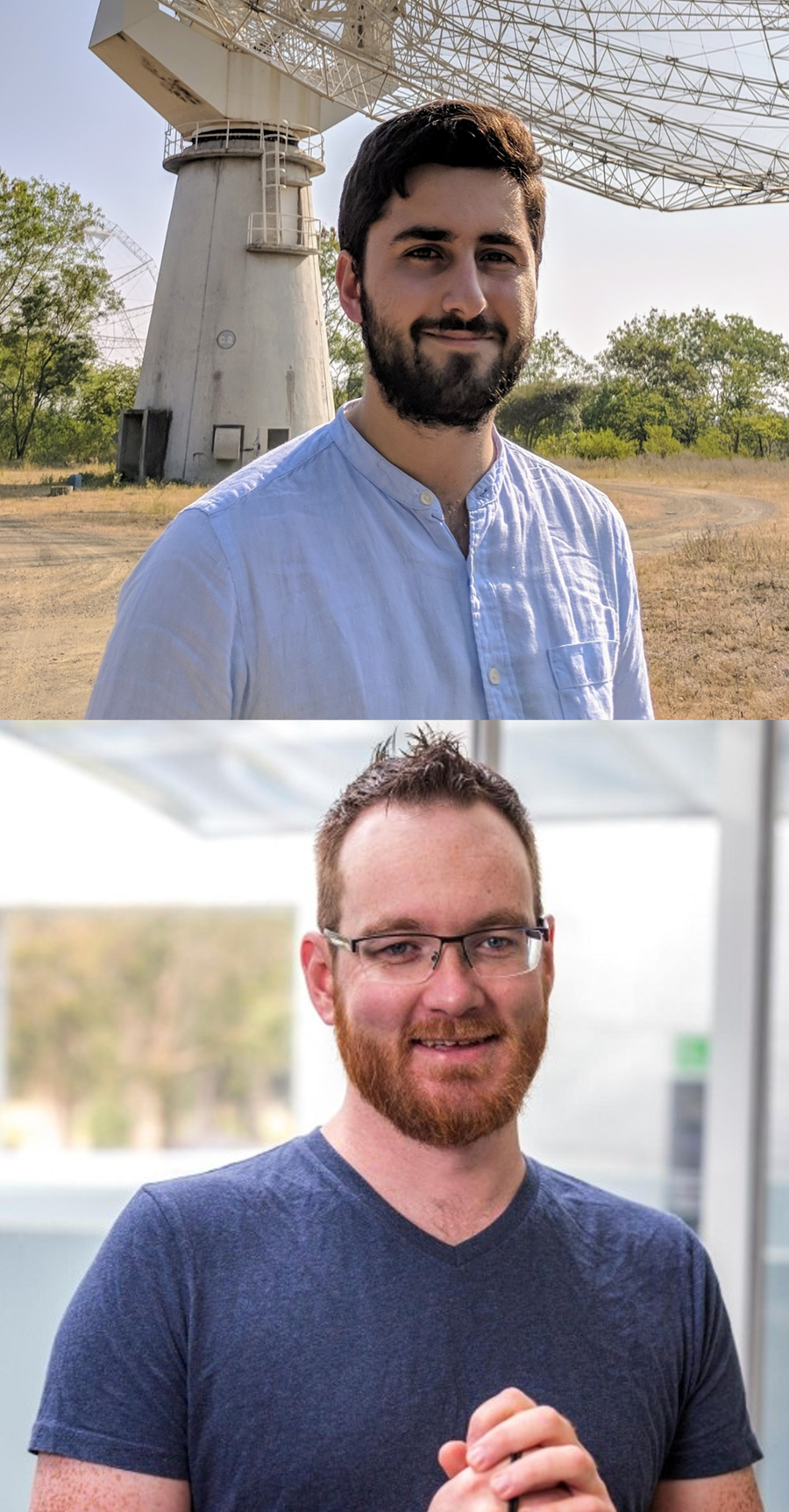
Two separate photos of smiling men.
Dr Andrew Zic, ATUC Executive Officer and Dr Tim Galvin, TAC Executive Officer

Andrew Zic, ATUC

Andrew Zic is the new Executive Officer for the Australia Telescope User Committee, taking over the role from Vanessa Moss. He is also one of our Bolton Fellows, researching time-domain radio astronomy using Australian and international radio telescopes to investigate the sky from millisecond to decade-long timescales.

As Executive Officer of ATUC, Andrew coordinates the meeting and ensures all relevant documentation is produced before and after the meeting. He is the interface between CSIRO and the User Committee, which is made up of those from all around the world who use the ATNF for their research. Find out more on ATUC.

Tim Galvin, TAC

Tim Galvin is the new Executive Officer of the Time Assignment Committee (TAC), taking on the three-year appointment from Elizabeth Mahony. Tim is our ASKAP data specialist, supporting the data production and management of the ASKAP pipeline. A member of several  ASKAP survey science teams, he also supports MWA’s GLEAM survey.

The TAC assesses proposals submitted to the ATNF on their science and technical merit and meets twice a year. As Executive Officer of the TAC, Tim plans, organises and facilitates the assessment meetings and processes. Find out more about the TAC.

Management of RFI

To ensure our users can continue producing exciting and cutting-edge science with the ATNF telescopes, we must stay ahead of the challenges created by radio-frequency interference (RFI). This interference can come from sources such as aircraft, satellites and electrical devices including computers, radios, TVs and mobile phones. Here are the five key areas we work across to protect our telescopes and minimise the impact of RFI on scientific observations:

  1. Spectrum regulation
    The radio spectrum is regulated internationally by the International Telecommunications Union – Radiocommunications Sector (ITU-R) and, at the national level, by the Australian Communications and Media Authority (ACMA). We work with both agencies and have done for over 50 years. 
  2. Local protections
    Our telescopes are in regional and remote locations with relatively low population density, often surrounded by low hills, to avoid sources of ground-based interference. These sites are supported by legislative instruments, such as ACMA’s Radiocommunications Assignment and Licensing Instructions, that provide additional protection for the sites from RFI.
  3. Mitigation activities
    We’ve developed, and are constantly working on, software and methods to filter out signals at frequencies associated with known sources of interference.
  4. Monitoring and measurement activities
    We undertake active monitoring at our sites using dedicated receivers for monitoring interference and participate in research to characterise unintended emissions from satellites and aeroplanes.
  5. Collaboration activities
    We are working with satellite and mobile telecommunications operators to minimise interference to radio astronomy.

We’ll focus further on these different areas in future newsletters, so keep an eye out or head to our website.

ATNF flashback

An international general assembly

In August 1952, URSI convened in Sydney. It was one of the first international science meetings to ever be held in Australia. Here, it was announced that discrete radio sources from space were not from stars, but possibly nebulas and galaxies! All the founders of CSIRO Radiophysics are in this image.

Events and reminders

Happy Holidays card with a picture of Murriyang, our Parkes radio telescope on it

Upcoming meetings we'll be at:

  • Asia-Pacific SKA Meeting, Chiang Mai Thailand, February 2026
  • ACAMAR, Australia, March 2026
  • APRIM, Hong Kong, May 2026
  • ASA Annual Scientific Meeting, July 2026
  • SPIE Astronomical Telescopes and Instrumentation, Copenhagen, Denmark, July 2026

Upcoming ATNF events:

Acknowledgement

We acknowledge the Traditional Owners of the lands of all our sites and pay respect to their Elders past and present.

  • The Astrophysics Lab, Marsfield, Wallumattagal
  • Paul Wild Observatory, Narrabri, Gomeroi People
  • Parkes Observatory, Parkes, Wiradjuri People
  • Mopra Observatory, Coonabarabran, Gamilaroi People
  • ARRC, Kensington, Whadjuk People of the Noongar Nation
  • WA Observatory Support Facility, Geraldton, Nhanhangardi, Naaguja, Wilunyu and Amangu Peoples
  • Inyarrimanha Ilgari Bundara, our Murchison Radio-astronomy Observatory, Wajarri Yamaji