ATNF News 8 | June 2026
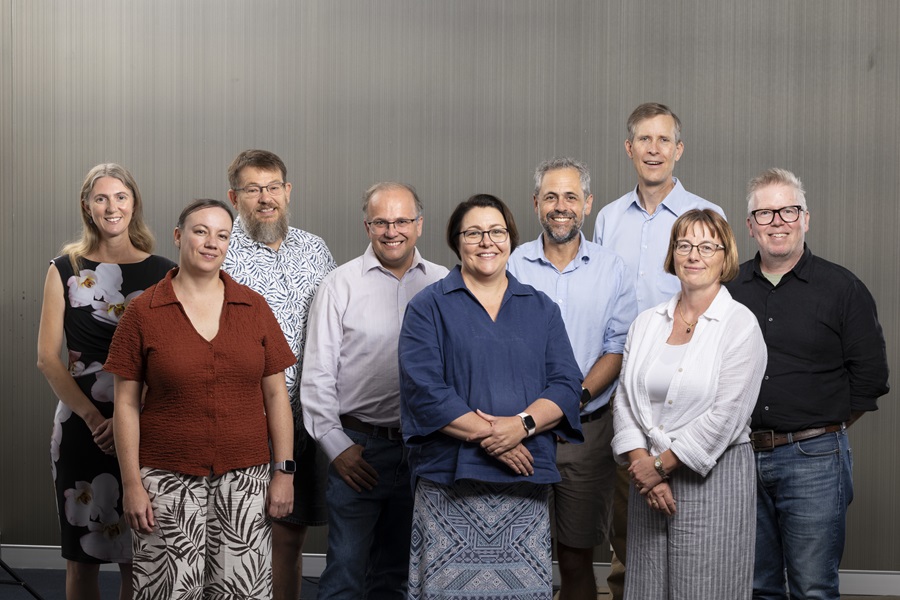
Douglas Bock, ATNF Director
Since the last ATNF Newsletter in December, activity across the ATNF has continued at an extraordinary pace. It has been particularly exciting to see our major instrumental projects translate into new observations and early science outcomes.
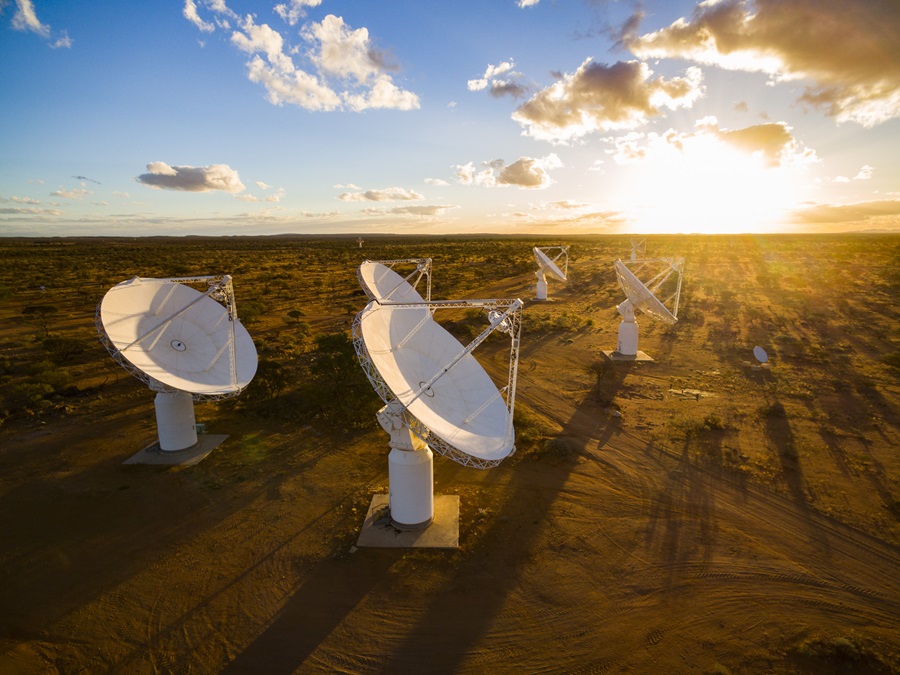
The Australia Telescope Compact Array (ATCA) backend upgrade, BIGCAT, is delivering its first observations, while at Murriyang, our Parkes radio telescope, we are beginning to see the first science results from the cryoPAF receiver system. Our ASKAP radio telescope also reached an important milestone recently, with FLASH becoming the first of the ASKAP science surveys to complete observations. It was wonderful to celebrate this achievement with both the FLASH science team and the ASKAP operations team, whose long-term dedication has made this possible.
This is also a reminder of the remarkable capabilities now available across the ATNF facilities and I thank everyone who submitted a proposal to use these capabilities. At the same time, we are continuing to invest in future capabilities, including the accelerated development and installation of the new ultra-wideband receiver suite for Murriyang, described later in this newsletter.
Together with the Australia Telescope Users Committee (ATUC) and the Australia Telescope Steering Committee (ATSC) we have been building a picture of our future as the SKA telescopes come on line and our own telescopes complete today's missions. One highlight for me personally was the ATNF Futures 2030 Workshop held in February, where astronomers and engineers from CSIRO and around the world came together to explore ambitious ideas for the next decade of Australian radio astronomy. A summary of that workshop is included later in this newsletter.
I hope you enjoy this edition and, as always, thank you to everyone across the ATNF community whose work continues to drive these facilities, discoveries, and future opportunities forward.
Celine D’Orgeville, ATNF Program Director
During my presentation to the ATUC meeting in March, I asked for feedback on this newsletter and suggestions on the kinds of updates you would most value. We greatly appreciate your input, which has directly influenced several additions to this edition, including expanded facility updates and more detailed reporting on progress related to ATUC recommendations.
Over recent months, we have undertaken significant recruitment across our operations team and found opportunities for co-funded postdoctoral positions. CSIRO also offers Industry PhDs to create links with university and industry partners and we are exploring ways for ATNF to provide short-term industry internships for postgraduate students. Reach out to me if your university would like to be involved in any of these initiatives.
We are very pleased to welcome Dr Jayender Kumar as a co-funded postdoctoral researcher working jointly with CSIRO and Macquarie University, alongside Samual Lai as our newest Bolton Fellow and many new electricians, electrical engineers, mechanical engineers and apprentices at our observatories. Congratulations to Kannan Krishnan who was a finalist for Apprentice of the Year in northern NSW's New England region.
George Hobbs, ATNF Head of Science
We recently held the ATNF Radio School at our Paul Wild Observatory with over 100 international and national participants online and in person. Thank you to the organising team, lecturers and tutors for creating such a valuable event. There were sessions on data reduction, continuum spectral line analysis, proposal writing, observing with our telescopes and more. Occurring every two years, the next one will be in 2028.
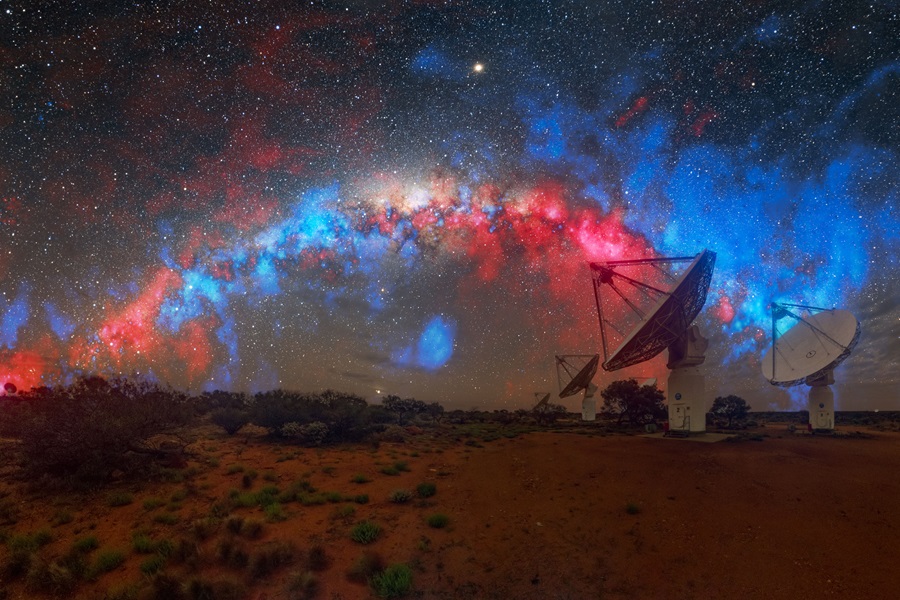
Skills developed at Radio School play out across the years with previous attendees and current lecturers receiving huge acclaim for recent work. The SPICE-RACS release, completed using RACS data from ASKAP, has produced the most detailed map of cosmic magnetism to date (pictured), replacing nearly 20-year-old data from the northern hemisphere. Congratulations to the team! See our data facility update below for more information on how to access SPICE-RACS.
Looking to the future, the ATNF Town Hall at the ASA meeting will provide an opportunity to continue discussions that were initiated by the ATNF Futures 2030 workshop. The details of this and several other events where we will have a presence are at the end of this newsletter. I hope to see you there.
Andrew Zic, ATUC Executive Officer
The most recent Australia Telescope Users Committee (ATUC) meeting was held in Perth in March. Presentations are available within the program outlined on the March meeting webpage. The committee's report (available as a downloadable pdf) highlighted a number of significant achievements across the ATNF, including the successful commissioning of BIGCAT, the continued high-impact science being delivered by Murriyang, the completion of multiple iterations of the Rapid ASKAP Continuum Surveys (RACS), and the broad range of activities underway to support and grow both the current and future ATNF user community.
Some of the key recommendations are:
We thank the committee for their report and specifically thank Dr Stanislav Shabala who has completed his term as ATUC Chair. We welcome Dr Nick Seymour into this role and look forward to seeing everyone at the next meeting from 3 to 4 September in Marsfield, Sydney.

Data archives
There has been significant work by our archives team to ensure ATNF data sets are secure and accessible. We have obtained significantly more data storage for CASDA, which will provide the required amount for the completion of the ASKAP key surveys. Our intention is also that CASDA will store the ATCA, LBA and Murriyang continuum and spectral line observations. We have started transitioning data files from the Australia Telescope Online Archive (ATOA) to CASDA and expect to complete that work over coming months.
The SPICE-RACS Data Release 2 is available. The Spectra and Polarisation In Cutouts of Extragalactic Sources from the Rapid ASKAP Continuum Survey (SPICE-RACS) is 130 TB and includes cutout image cubes in Stokes I, Q, and U of 4 million detected sources, and polarisation spectra of over 5 million radio components, from the whole southern sky visible to ASKAP.
Murriyang
The cryoPAF receiver is now available for mainstream observations. Near the end of the 2026OCT semester we expect that the ultra-wideband receivers operating across mid and high frequency bands (UWM/H) will be in the commissioning phase. As part of this upgrade the ultra-wideband low (UWL) receiver will not be available for 6 to 8 weeks in the second half of the semester (Feb/Mar – Apr 2027). Engineering commissioning for the UWL/M/H would follow this at the very end of the semester into the start of the 2027APR semester.
ATCA
The full 8 GHz BIGCAT system is now available, providing users with double the instantaneous bandwidth compared to the previous backend. BIGCAT also allows for increased flexibility and reliability of ATCA, with more spectral line configurations on offer. See the latest call for proposals for a list of standard BIGCAT observing modes on offer.
ASKAP
No major disruption expected in the coming months, but we are planning for a hardware refresh of the ingest cluster at the Pawsey Supercomputing Research Centre. A summary of ASKAP scheduling and survey science project status is available on our website.
LBA
With recent upgrades at partner observatories, all recorded data can now be e-transferred directly from the telescopes to Pawsey, without any intermediate shipping of disks, which will significantly reduce the time between observations and data correlation. Successful tests have been made with the India’s GMRT, South Africa’s MeerKAT, and the Thai National Radio Telescope, providing the opportunity to include these telescopes in future LBA observations.

Cathryn Trott, ATNF Chief Scientist
We held a two-day in-person and online workshop in February for the community to provide a vision for post-2030 instrumentation and facilities for Inyarrimanha Ilgari Bundara, our Murchison Radio-astronomy Observatory.
With ASKAP's current surveys expected to be completed by 2030, we can think big about where ATNF might go in the SKA era. To generate ideas and discussion, three broad concepts were provided to the community prior to the workshop: an ASKAP upgrade path, a different mid-frequency dish array, and a mid-frequency aperture array.
Almost 100 Australian and international participants joined us each day in Marsfield, with more online. Broadly, participants enthused about wide-field instruments and wide-band feeds, as enablers of much of the unique science undertaken with the current ATNF telescopes. They expressed concern for astronomy in a future with RFI and suggested this could be a future area of focus for ATNF. And they described a future where ATNF is complementary, but not competing, with the SKA telescopes. The slides and presentations from the workshop are available on the event webpage, and the outputs are feeding into a broader discussion about our future strategic plan.
Shi Dai, Project Scientist for the UWM-H project
We’ve been working towards installing a suite of ultra-wideband single pixel receivers that provide 700 MHz to 30 GHz frequency coverage on Murriyang for more than a decade. Along with survey capability provided by the cryoPAF receiver that is currently being commissioned, this receiver suite will significantly extend the capabilities of the telescope.
This suite of ultra-wideband receivers will enable more use of Murriyang in LBA observations and open new opportunities across pulsar science, fast radio bursts, spectral-line studies, transient astronomy, and spacecraft tracking.
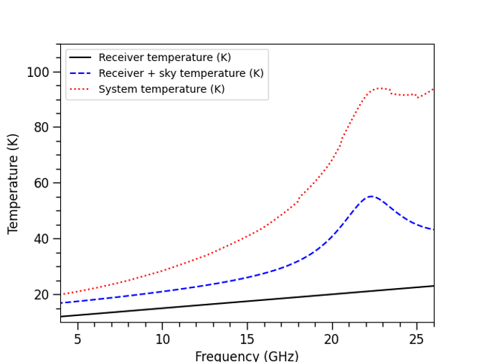
In 2018, the ultra-wideband low frequency receiver (UWL), was installed with its associated signal processing systems. And this year will welcome the ultra-wideband mid and high frequency receivers (UWM-H) as well as a receiver specifically designed for space-craft tracking (the ultra-wideband spacecraft receiver). The frequency bands that will be available through the new receiver suite are given in the list below with the expected receiver and system temperature shown in the image.
The installation of these receivers will also allow us to upgrade the existing ultra-wideband low-frequency receiver with a new digitiser system, better low-noise amplifiers and an improved noise source. This upgrade will also enable an over-sampled filterbank (compared with the existing critically-sampled filterbank) and will significantly improve on the bandpass obtainable with the current system and provide higher sensitivity.
From a user perspective, the new receivers will expand the available frequency coverage, while the observing systems, monitoring tools, data formats and software tools will remain largely unchanged.

Tommy Marshman, Macquarie University co-supervised student:
Our team from CSIRO and Macquarie University developed and compared three radio frequency interference (RFI) mitigation algorithms that were applied to observations taken with the Murriyang UWL receiver in the Wi-Fi and Bluetooth bands.
We began by characterising RFI in the 2.4 GHz band since the commencement of the UWL receiver observations in 2019. The dominant interference sources were the expected Wi-Fi and Bluetooth transmissions. Their intensity and directionality varied with time of day and evolved over the time period. This observing band is usually discarded by our users because of the RFI, but we found that the interference is confined in both time and frequency and can therefore be effectively mitigated through our algorithms which are applied to voltage data streams. We showed that a real-time implementation of any of these algorithms would increase the usable fraction of this 128 MHz observing band from about 30% to more than 90%.
The figures present folded Vela Pulsar profiles before and after applying mitigation methods, with power levels normalised. The top figure shows unmitigated data dominated by strong channelised RFI, obscuring both the pulse profile and bandpass, while the bottom figure shows improved mitigation using spectral kurtosis, a simple power threshold, and a combined averaged and simple threshold applied to demodulated data.