Blog icon

National Science Week - mission accomplished!

Thank you for taking part in CSIRO Robot Responders. Together, we reached more than 80,000 young people during National Science Week, with registrations from every State and Territory in Australia. Along the way, more than 11,200 participants also took on real-world challenges through the CSIRO Robot Responders online game. 

Read on for more ideas and resources to help keep young people engaged with Science, Technology, Engineering and Mathematics (STEM) all year round, and to find out the winners of the CSIRO Robot Responders competition.

Explore the CSIRO Education Resource Library

National Science Week may be over, but CSIRO Robot Responders resources can be accessed at any time in the CSIRO Education Resource Library, making it easy to continue exploring robotics, problem-solving and STEM in classrooms, homes and community groups. You can also discover a wide range of other free educational resources that draw on real-world science to create engaging learning experiences aligned with the Australian Curriculum.

Congratulations robot design competition winners

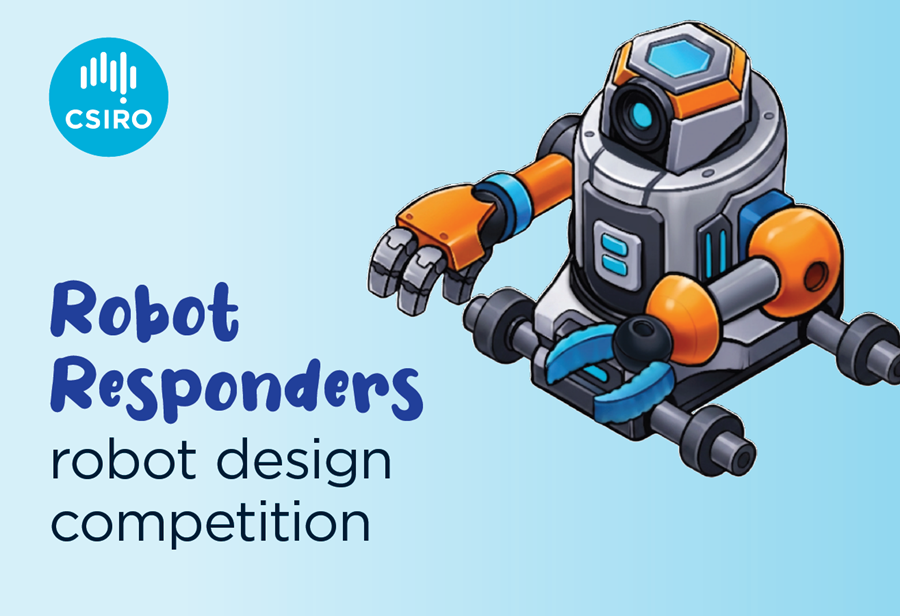
Promotional graphic for the CSIRO Robot Responders robot design competition. The image features an illustrated search-and-rescue style robot with orange, blue and grey mechanical arms and grippers on a light blue background. The CSIRO logo appears in the top left corner alongside the text “Robot Responders robot design competition”.

Our judges were blown away by each of the more than 150 entries submitted to our CSIRO Robot Responders robot design competition.

It wasn't easy, but after careful consideration, the following students have been named winners and runners-up. Congratulations to the talented young innovators below.

Overall winners:

  • Year 7 and above: Tate B. for Reconnaissance Robot: a robot that surveys dangerous environments like collapsed buildings, chemical spills, or bomb threats, without risking the safety of human workers.
  • Year 6 and under: Max S. for Ranger Robot: a bio-inspired climbing robot modelled on an inchworm to access hard-to-reach nesting sites to monitor and protect endangered red-tailed black cockatoos.

Runners-up:
Khalissa K. (Isopoda); Neve S. (Claw Enforcer); Madison C. (Bite & Titan); Walter B. (Ocean Wing); Leo E. (Robee Rescue Robot); Emi H. (H5N1 Robot); Anaya Y. (Archimedes Lifesaver Robot); Joseph N. (Underwater cave-exploring robot); Amy Z. (Robotic Clownfish); and Evelyn L. (Turtle Robot).

Highly commended:
Harris F. (Phoenix); Edward G. (Mars Aerial Rescue); Michael B. (Claytron); Samuel R. (Orbital Recycling Probe); Brady B. (Space Repair Robot); Lovelle J. (Aurora Ocean Guardian); Jack V. (Jimmy); Ryan C. (Space Debris Robot); Adaline Y. (CADR); Karim M. (Space Exploration Robot); and Thomas R.

School and community engagement recognition:
Bellerive Primary School (TAS); Eastwood Primary School and Deaf Facility (VIC); Lathlain Primary School (WA); Middle Park State School (QLD); Perth College (WA) and Lara Girl Guides.

To see some of the fantastic submissions, stay tuned to our Facebook page!
More resources to engage all ages in STEM

Practical tips 

STEM Conversation Toolkit

Download this free toolkit designed to help spark everyday conversations with your child about STEM. It offers simple ways to recognise opportunities, ask questions and explore ideas together. Rather than focusing only on school subjects or future careers, you'll find strategies for connecting STEM to everyday life, from hobbies and news stories to everyday curiosity about how the world works.

Read more
Virtual storytime

Meet 'Bear to the Rescue'

Watch a special recording with the authors of 'Bear to the Rescue', featuring a guest appearance by koala detection dog Bear himself! Released during National Science Week, this heartwarming story explores how science, teamwork and determination can help protect Australia's unique wildlife. While aimed at younger audiences, the story can be enjoyed by readers of all ages.

Watch here
grant opportunity

National Science Week 2027: grant funding now open

Applications are now open for National Science Week 2027 grants. Individuals and organisations can apply for grants of between $5,000 and $20,000 to deliver events and activities that engage communities with science. Click below to find out if you're eligible or to apply before 6 October 2026.

Apply here