Key points
- Coolbinia Primary School has partnered with STEM Professionals in Schools (SPS) for almost two decades, connecting students with STEM experts ranging from mycologists and roboticists to astrophysicists.
- Award-winning educator Ian Wilson says the best STEM partnerships are built on collaboration, helping students connect classroom learning with real-world STEM while giving teachers fresh ideas and expertise.
- By connecting students with STEM professionals, programs like SPS help foster curiosity, creativity and critical thinking, equipping young people with skills for a rapidly changing world.
For almost two decades, Coolbinia Primary School in Perth, Western Australia, has partnered with STEM professionals in Schools to connect classroom learning with people working in STEM.
It all started in 2010 with a fungi project.
As part of the school's Fungi Fandango project, students and staff were partnered with a mycologist through STEM Professionals in Schools, who led a series of fungi forays through the nearby Coolbinia Bushland. The experience proved so inspiring that many participants went on to conduct their own fungi forays, and it sparked a long-running relationship with the program that continues today.
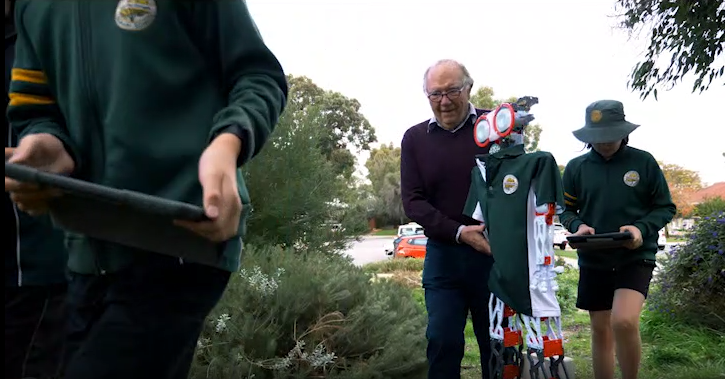
Since then, the school's involvement in STEM Professionals in Schools has continued to grow, expanding to new STEM fields and partnerships. One longstanding collaboration has been between the school’s Digital Technologies Specialist Teacher and STEM Leader, Ian Wilson, and STEM professional Geoff Kaye. Together they have supported students to achieve success in robotics competitions, develop award-winning inventions and create the school's interactive STEM Bush Trail.
The next chapter is already underway. This term, Ian has secured an exciting new partnership through SPS with astrophysicist Dr Karen Lee-Waddell. Drawing on Karen's expertise in astronomy, students will have opportunities to explore topics such as the Sun, Moon and Earth, gravity, galaxies and the wider universe, from someone whose day job is literally trying to understand the Universe.
"These partnerships bring STEM to life, helping students see how their learning connects to the real world," said Ian. "As teachers, we learn just as much, gaining new knowledge, confidence and inspiration to explore possibilities we might never have considered."
We caught up with Ian, who was recently named the 2026 ACCE/ACS Australian Digital Technologies Teacher of the Year and received the 2026 ACS WA 1962 Educator Award in recognition of his significant contribution to ICT education.
Read on for his perspective on the power of SPS partnerships, the importance of curiosity, what excites him about this generation of students and how we can support them in a rapidly changing world.
Q: From your experience, what makes a great partnership between an educator and a STEM professional?
For me, it's about relationships, collaboration and a shared enthusiasm for learning. The best partnerships are genuinely two-way. Teachers understand their students and how they learn, while STEM professionals bring specialised expertise and fresh perspectives. Just as importantly, it's about bringing other staff on the journey, sharing ideas and creating opportunities for teachers and students across the school to get involved.
A recent CSIRO partner and school parent, Audrey Bester, brought wonderful enthusiasm and ideas to our Science Week-inspired bushland learning, while recognising the expertise teachers bring. When everyone feels valued and enjoys learning from each other, that's when great things happen!
Q: What is one thing STEM professionals are often surprised to learn when they step into a classroom?
I think they're often surprised by just how capable and creative primary school students can be! As a Sustainable School, we encourage student voice and leadership, giving children opportunities to identify real environmental challenges and take action to make a difference. Our River Rangers, for example, investigate issues affecting our local environment and explore practical solutions. It's wonderful watching students take ownership of these challenges and coming up with ideas that even adults might not have considered. I think our STEM partners are often just as inspired by the students as the students are by them!
Q: Digital technologies, AI and digital citizenship are evolving rapidly. What skills, mindsets or habits do are most important for students to develop today and how can SPS partnerships help foster these?
I believe curiosity, critical thinking, creativity and digital citizenship are more important than ever. With AI increasingly able to generate answers, students need to know how to ask good questions, evaluate information and think independently. I want children to be creators of technology, not simply consumers of it. STEM partnerships provide wonderful opportunities to develop these skills through authentic challenges, while helping students see how professionals use technology responsibly, creatively and collaboratively to solve real-world problems.
Q. What gives you the most optimism about the next generation of students entering STEM?
Without doubt, it's the students themselves! Their curiosity, creativity and genuine desire to make a difference never cease to amaze me. Whether they're designing technology to solve a problem, investigating our local bushland or finding innovative ways to protect the environment, they're already showing us what they're capable of. If we continue providing opportunities to explore, question, collaborate and take risks, I think the next generation will achieve things we can barely imagine today.