Key points
- CSIRO has added four unique Australian orchids to the International Union for Conservation of Nature (IUCN) Red List, helping raise global awareness and support for these extraordinary species found nowhere else on Earth.
- Orchids in CSIRO's collection have revealed pollination decline since the 1970s. What’s causing it?
- CSIRO is digitising 25,000 dissected orchids to make this unique collection globally accessible.
Australia is home to more than 1,800 orchid species — many found nowhere else. But these unique plants face growing threats. Australia is home to more than 1,800 orchid species — many found nowhere else. But these unique plants face growing threats.
For research scientist Dr Heidi Zimmer, her favourite orchid changes over time, but today it’s the Common Onion Orchid (Microtis unifolia).
It's small and underrated, but under a microscope this orchid is really beautiful,” said Dr Zimmer.
“The leaf is like a chive leaf and its tiny green flowers crowd along the stem, each with a teeny-tiny crenulated lip.”
What's your favourite orchid?
The Common Onion Orchid grows down the east coast of Australia as far as Tasmania in woodland and grasslands, near creeks and dams, and sometimes even in paddocks and lawns.
“The tiny flowers make them difficult to identify. There are probably several undescribed species of Onion Orchid. We are still learning about Australia’s orchid biodiversity, with new species added to our checklist each year,” she said.
For Dr Zimmer, every orchid tells a story about Australia’s biodiversity — and why it’s worth protecting.
Dr Zimmer has worked on orchids for a decade, starting in conservation before moving to taxonomy, which is the science of classifying species. Understanding what species exist is the first step to protecting them — especially as threats grow.
“The two fields work hand in hand to catalogue and conserve species,” she said.
How threatened are Australia’s orchids?
Thanks to Dr Zimmer and a dedicated group of volunteers, four more Australian orchids were added to the International Union for Conservation of Nature (IUCN) Red List of Threatened Species this year. They joined 23 species added in 2022.
While hearing about more threatened orchids might sound alarming, being listed on the Red List actually helps by attracting global attention and opening doors to funding opportunities.
Dr Zimmer recently worked on a study to assess how threatened the world’s orchids really are.
“One of the biggest challenges in orchid conservation is taxonomic uncertainty, meaning that in some groups it’s difficult to know where one species ends and another begins,” she said.
“An example is Oberonia attenuata, an Australian orchid we added to the Red List in 2022. But before we could do that, we had to get it officially recognised as a species separate from a more-widespread orchid species that grows overseas.
“It’s the only epiphytic, or tree-dwelling, orchid that we’ve added to the Red List. Most Australian orchids are terrestrial, meaning they grow on the ground. Many of these terrestrial orchids actually spend a large part of their lifecycle underground, hiding away from unfavourable conditions, such as drought.”
A canary in the coalmine
In another study, Dr Zimmer worked with a team of researchers from the Australian National University to find out about changes to insect pollinators by looking at orchid specimens in the Australian National Herbarium — a joint venture between Parks Australia and CSIRO.
“Specimens are like a time capsule, collected and preserved for decades or even centuries,” Dr Zimmer explained.
“Caladenia orchids, which are also known as spider orchids, have open-shaped flowers with visible pollen sacks that look like yellow blobs. We can compare specimens to see if their pollen sacks are present or absent — indicative of pollination services — and see whether there have been any changes over time.”
The results of looking at 10,000 specimens of spider orchids dating back 50 years revealed a decline in pollination services since the 1970s. Why? Dr Zimmer believes there could be various reasons, such as pesticide use or climate change.
“Similar results are being seen in other studies overseas. Specimens are telling us the problem exists and providing the evidence of this change.”
Digitising decades of discovery
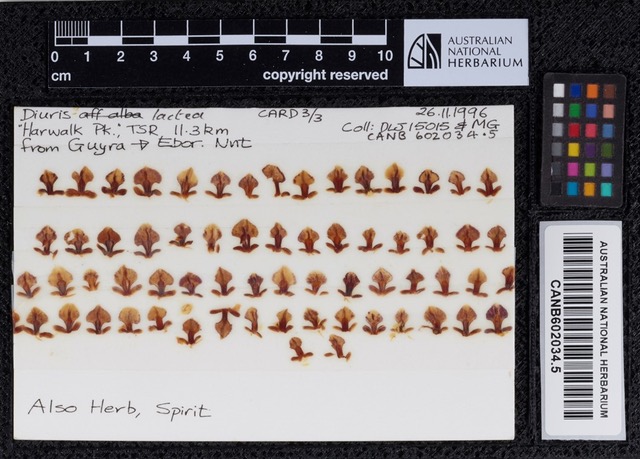
The Australian National Herbarium contains a special collection of dissected orchids, their petals taped flat on small cards to show their structure — often in much clearer detail than on standard herbarium sheets. The herbarium’s collection of 25,000 orchid floral cards is still growing as researchers make more.
Thanks to a grant from the Australian Orchid Foundation, CSIRO is digitising the cards and making high resolution photographs available to researchers all over the world. This will let the orchid specimens contribute to future studies to support biodiversity and conservation of nature.