
Key points
- Water treatment technology developed for mining is being adapted to help remote and Indigenous communities access safer, more reliable drinking water from groundwater.
- Groundwater can contain high levels of dissolved minerals and microbial contamination making it unfit for human consumption.
- At Mungalla Station in North Queensland, the Nywaigi people are working with CSIRO on a pilot that pairs water treatment technology with local ecological knowledge, and trains community members to run it.
Poet Dorethea Mackeller may celebrate a sunburnt country, but Australia’s dry and arid inland poses a less romantic reality for some remote and regional communities, where access to clean, reliable water is a daily challenge.
Mungalla Station near Ingham in North Queensland is owned by the Nywaigi Traditional Owners who operate history and cultural tours. The mains water is piped along the road, passing the front gate – more than a kilometre from the homestead.
The historic cattle station and leading ecotourism site must truck water in for Mungalla’s guests, including tourists and school groups, who visit the station to go on tours or stay at the campground.
Bore water - water pumped from groundwater sources like underground aquifers - is available at the station but the quality is not fit for direct use.
“Town water is available at the entry of Mungalla Station along Forest Beach Road but needs to be plumbed into the Homestead, approximately 1.2 kilometres," said community spokesperson Jacob Cassady.
"If our bore water was fit for consumption, it would provide a year-round safe water supply that is also suitable for drinking,”
Groundwater pressures
Continuous access to potable water is a luxury in parts of remote Australia. Seventy per cent of our country’s land mass is classed as arid or semi-arid. Water resources may be scarce and what water there is in some remote locations can be unfit for human consumption.
Groundwater carries with it whatever the surrounding rock contains. Often that’s a lot of salts and, in some instances, microbial contamination, which renders the water unsafe for humans.
Water resources are also susceptible to climate and weather variabilities. Australia has warmed by 1.51°C since 1910, and though changes in rainfall patterns vary widely, streamflow has fallen at more than a quarter of the country’s reference river gauges. Meanwhile, national water consumption rose 12.9 per cent in 2023-24.
How the mining sector’s expertise evolved

Australia’s mining industry has spent decades dealing with water issues.
Mine operations, ore processing, tailings management, cooling and dust suppression require water and the management of mine impacted water from many of these operations is difficult to treat.
Water engineers treat water that is often saline, acidic, and / or heavy with dissolved minerals.
In February, Geoscience Australia estimated that mining accounts for 11 per cent of gross domestic product and directly employs about 300,000 people. The sector also consumed 749 gigalitres of water in 2023-24, second only to agriculture, forestry and fishing in water use by industry.
CSIRO has spent years working with the mining sector to develop technologies used in water management.
Expertise gained helping the industry to innovate under these harsh conditions is now helping solve ongoing issues of water supply in remote Indigenous communities.
The brine problem
Every desalination process concentrates the salt it removes into a waste stream. On the coast, that brine can go back to the ocean. Inland, options are far fewer.
“Inland communities either hold desalination waste in ponds, or truck it a long way for disposal,” said CSIRO research team leader and senior water research scientist, Dr Ramesh Thiruvenkatachari.
“Reducing the brine volume from these plants delivers both an environmental and an economic benefit.”
CSIRO-developed technology directly targets this issue and uses a thermal membrane, tested through the Australian Coal Association Research Program on coal mine brines and acidic mine water. It has now moved from the laboratory to pilot and prototype units.
A more ambitious plan for the group is investigating whether waste brine might become a feedstock rather than a cost. A project underway with Australia’s CO2CRC has progressed to a proof-of-concept stage, capturing carbon dioxide from industrial flue gas and combining it with brine to make a saleable product.
“We’re trying to combine waste streams from two different industry sectors to create value,” said Dr Thiruvenkatachari.
From mining to drinking water
The shift from addressing mining wastewater, to helping communities secure potable water, involves a change in approach.
Dr Thiruvenkatachari says understanding the unique issues of the area and working with the community to understand their needs is crucial.
“We are not trying to fit what we have used for mining and industry to other needs,” said Dr Thiruvenkatachari.
“It’s more collaborative than consultative – working with the end user, understanding their needs and developing solutions accordingly.”
The link between the sectors is not shared hardware, he says, but rather that water is contested and mines do not sit apart from the country around them.
However, while mine sites generally have power, roads and staff, remote communities often have none of these, and their needs can change dramatically through the year, as people travel and cultural events draw crowds.
“Within the same community, the use requirements can be quite different,” said Dr Thiruvenkatachari.
“Livestock can tolerate higher salinity water but for drinking purposes there are more stringent requirements.”
Built for handover
At Mungalla, technical solutions form just one part of the project. CSIRO is working with the Nywaigi people on a nature-based treatment approach, drawing on local knowledge of plants.
This world-first, co-designed system uses all-natural bio-carbon from local plants. Indigenous knowledge informed the selection of renewable, plant-based biomass from lands connected to Country as feedstock to create a functional water treatment material that removes naturally occurring contaminants.
“Indigenous partners bring a wealth of knowledge on ecosystem and environmental management,” said Dr Thiruvenkatachari.
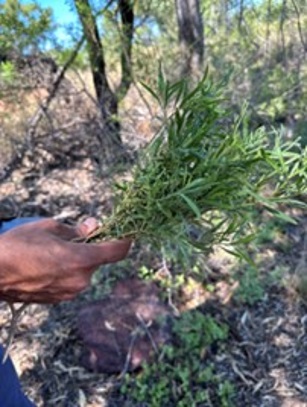
“They know the right plant material, and we know how to turn that into structured carbon. Working together, we can see what material can be used, apply it back to the land, and use it to clean the water from that land.”
That contribution is formally recognised.
“We work collaboratively, respectfully acknowledging their input and their IP,” he says.
The partnership also includes other Indigenous communities, training organisation and local representatives so local people can operate and maintain the unit and the community can run it without outside help.
“The importance of this collaboration with CSIRO will support our hopes and dreams of our Ancestors and for our people today to leave a living legacy for our younger generation to continue the work on Mungalla Station,” says a community spokesperson, Jacob Cassady.
Noel Gertz from project partner and training organisation, On Common Country, rates the project highly.
“The partnership with CSIRO will also add to the provision of support for the communities to become more sustainable,” said Noel Gertz.
“This new initiative has the potential to be of major benefit to the Nywaigi people and others in the surrounding region.”