
Key points
- A new Royal Australian Mint coin collection Bright Ideas celebrates five Australian inventions that have changed the world, including CSIRO’s high-speed Wireless LAN (WLAN) technology
- Invented in the 1990s, high-speed WLAN overcame a challenge no other organisation could solve at the time and paved the way for the fast Wi-Fi that is now used worldwide every day
- The coin’s release in our Centenary year honours the enduring impact of CSIRO science on lives of every day Australians
CSIRO science is world-changing. And you can take that to the bank!
Take wireless connectivity. It’s hard to imagine life these days without it. Every day, people across the world rely on it to work, learn, access services, run businesses and stay connected with family and friends, often without giving it a second thought.
But three decades ago, achieving a fast, reliable wireless connection was a challenge yet to be overcome. Now, our role in solving this obstacle is being featured on a new Australian coin.
The race to be mobile
The early 1990s were a time of landline phones, public payphones and video rental stores, but it was also the cusp of the internet boom.
1991 saw the world wide web become publicly available, closely followed by improvements to web browsers and an explosion of internet activity in the years to follow. Simultaneously, bulky portable computers and mobile devices were becoming more common, particularly in business settings.
Companies across the world were trying to develop wireless networking systems that could free devices from their cables, however processing speeds were slow at around one to two megabits per second, and unable to keep up with the data-hungry multimedia applications of computers at the time.
An answer from a different field
It was at this time that a team of five CSIRO researchers working in our Radiophysics Division set an ambitious problem to solve. They wanted to build the world’s first high-performance wireless network, with a data transfer rate of 100 megabits per second, comparable to fibre optic networks of the time.
However, there was a key obstacle standing in the way - reverberation. Reverberation occurs when radio waves bounce around the surrounding environment such as furniture, causing an echo that distorts the signal, making it difficult to reliably transmit large amounts of data indoors.
Drawing on their expertise in radio astronomy, engineering, and complex mathematics known as 'Fast Fourier transforms' the team developed a novel method to overcome reverberation, culminating in the development of high-speed wireless local area networking, or WLAN.
A world-changing breakthrough
It was a significant breakthrough that paved the way for the connected world we know today. The technology ushered in an era of portable devices and by 1997, approximately one quarter of Australian households owned a mobile phone. Fast forward to today, and WLAN technology can be found in more than 20 billion devices worldwide.
Now, the Royal Australian Mint is recognising WLAN technology in its new Bright Ideas coin collection, that celebrates five inventions that have changed the world.
CSIRO Deputy Chief Executive Elanor Huntington said Wireless LAN technology is a powerful example of research ingenuity in action, and demonstrates the extraordinary impact that Australian science and innovation can have on a global scale.
“What began as a scientific challenge solved by CSIRO researchers has helped transform how billions of people connect, learn, work and communicate every day.” Elanor said.
“This new Australian coin comes at a particularly meaningful time for CSIRO as we mark our Centenary and reflect on the discoveries that have helped shape industries, communities and everyday lives.”
A piece of Australian history in your pocket
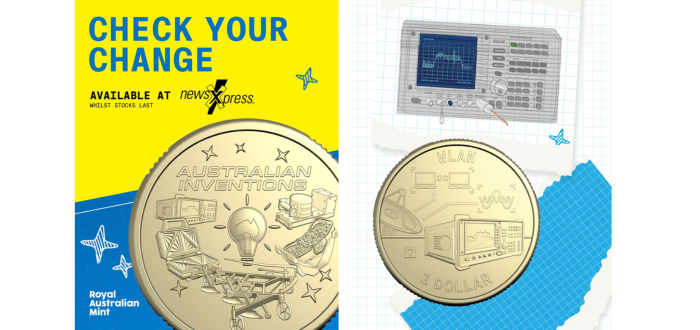
The Royal Australian Mint's Bright Ideas coin collection is available now and can be purchased via the Royal Australia Mint Shop or at participating NewsXpress outlets.
A special $2 Bright Ideas till coin will be also become available in circulation, so keep an eye on your change – you might just find a piece of Australian history.