
The Murray-Darling Basin is one of Australia's most significant river systems, crossing four states and one territory. It generates 40 per cent ($15 billion) of the gross value of agricultural production in our nation and supplies water to over 2.4 million Australians, including people from more than 50 First Nations.
For the past 50 years, the Basin has been gradually getting hotter and drier, while average inflows have decreased. This will have significant impacts on water availability and use for communities, industries and the environment.
Murray-Darling Basin Sustainable Yields Report 2025 (SY 2025) tells us how much water the Basin can safely supply — for farms, towns and the environment — now and into the future.
SY 2025 provides a whole-of-Basin assessment of the potential impacts of climate change on water resources. It helps to inform the 2025 Outlook Report and 2026 Basin Plan Review by providing an up-to-date climate change assessment.
This work helps industries, governments and communities plan ahead, and make evidence-based decisions about the Basin’s water resources.
Building on our work for the 2009 Sustainable Yields Report, CSIRO has leveraged significant advancements in climate science and modelling capabilities to contribute to modules on hydroclimate scenarios, groundwater assessment, and ecological thresholds of change.
Download the accessible text version
Our findings
The Murray–Darling Basin's climate is changing. With climate change:
- The Basin is virtually certain to be hotter.
- Annual rainfall is likely to become more variable.
- Heavy rainfall events are very likely to become more intense.
- Cool-season rainfall is likely to decline in the northern Basin and very likely to decline in the southern Basin.
The changes in the Basin climate are having significant impacts on water resources. SY 2025 shows that:
- Runoff and water availability are very likely to decline, particularly in the south.
- Droughts are very likely to become more frequent and severe, and may be of longer duration.
- The frequency of moderate flood inundation is likely to decline, but flood height and duration for large floods may increase.
- Long-term average annual flows are projected to decline – under current water management arrangements, this would have the greatest effect on downstream users and non-entitlement water.
- Groundwater recharge is projected to decrease, especially in the southern Basin.
Climate variability will continue to have a large effect on water resources. Basin climate is highly variable, with temperatures and rainfall varying widely from region to region, year to year or decade to decade. This variability will remain high and may increase with climate change.
High rainfall and runoff variability will dominate water availability in the near term to around 2030. Beyond 2030, climate change is likely to cause overall decreases in rainfall and runoff.
Sustainable Yields 2009
In 2009, the first Murray-Darling Basin Sustainable Yields project (SY 2009) delivered the most comprehensive and complex whole-of-basin water assessment ever undertaken in Australia.
The project was conducted by CSIRO together with the state jurisdictions, Commonwealth agencies and the then Murray–Darling Basin Commission. The team undertook an assessment of the likely impacts of climate change on the surface water and groundwater resources of the Murray-Darling Basin. This study was a world first in terms of the scale of the assessment.
The project, funded by the National Water Commission, reported on water availability and water use under historical and likely future climates, also considering possible changes in farm dams and forestry. It brought together nearly 200 people from more than 15 organisations, and involved assembling a complex computer-based model of the Basin's water resources. This was achieved, through linking 40 existing and new models of surface and groundwater supplies and extractions across the Basin’s 18 individual regions.
The final reports from SY 2009 can be accessed at CSIROpedia: Murray-Darling Basin Sustainable Yields Project reports
An overview of the project can be found at CSIROpedia Achievements: Murray-Darling Basin sustainable yields project
The Murray-Darling Basin is one of Australia's most significant river systems, crossing four states and one territory. It generates 40 per cent ($15 billion) of the gross value of agricultural production in our nation and supplies water to over 2.4 million Australians, including people from more than 50 First Nations.
For the past 50 years, the Basin has been gradually getting hotter and drier, while average inflows have decreased. This will have significant impacts on water availability and use for communities, industries and the environment.
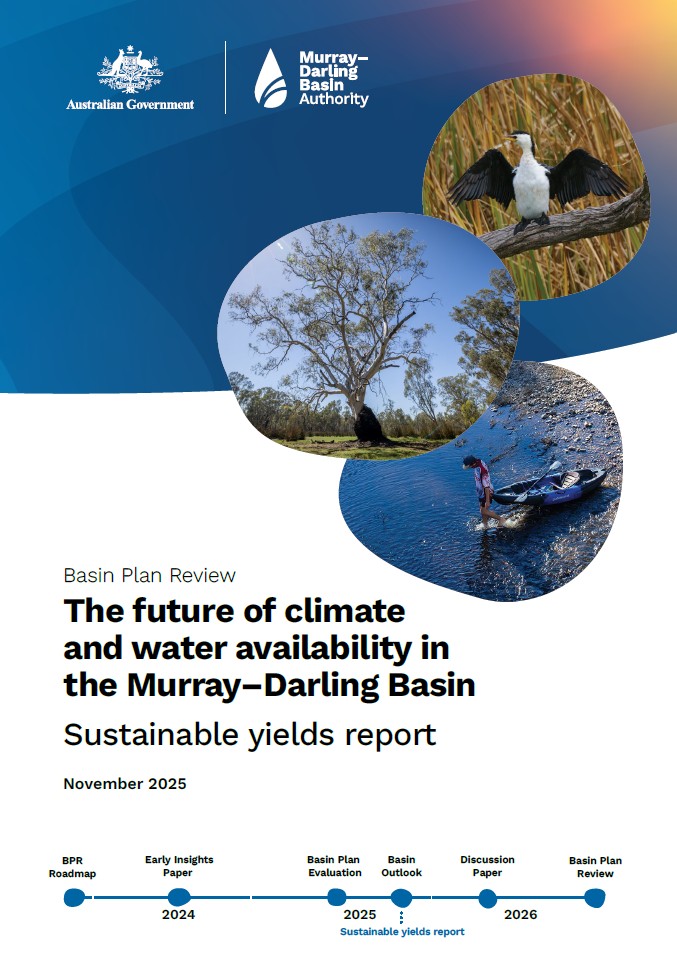
The cover of the Murray-Darling Basin Sustainable Yields 2025 report. The cover has the logos of the Australian Government and the Murray-Darling Basin Authority. It features three images of a waterbird, a eucalyptus tree and a person with a boat on the river. The title reads 'The future of climate and water availability in the Murray-Darling Basin - Sustainable yields report, November 2025'.
Murray-Darling Basin Sustainable Yields Report 2025 (SY 2025) tells us how much water the Basin can safely supply — for farms, towns and the environment — now and into the future.
SY 2025 provides a whole-of-Basin assessment of the potential impacts of climate change on water resources. It helps to inform the 2025 Outlook Report and 2026 Basin Plan Review by providing an up-to-date climate change assessment.
This work helps industries, governments and communities plan ahead, and make evidence-based decisions about the Basin’s water resources.
Building on our work for the 2009 Sustainable Yields Report, CSIRO has leveraged significant advancements in climate science and modelling capabilities to contribute to modules on hydroclimate scenarios, groundwater assessment, and ecological thresholds of change.
Download the full report PDF (5 MB)
Download the accessible text version
Our findings
The Murray–Darling Basin's climate is changing. With climate change:
- The Basin is virtually certain to be hotter.
- Annual rainfall is likely to become more variable.
- Heavy rainfall events are very likely to become more intense.
- Cool-season rainfall is likely to decline in the northern Basin and very likely to decline in the southern Basin.
The changes in the Basin climate are having significant impacts on water resources. SY 2025 shows that:
- Runoff and water availability are very likely to decline, particularly in the south.
- Droughts are very likely to become more frequent and severe, and may be of longer duration.
- The frequency of moderate flood inundation is likely to decline, but flood height and duration for large floods may increase.
- Long-term average annual flows are projected to decline – under current water management arrangements, this would have the greatest effect on downstream users and non-entitlement water.
- Groundwater recharge is projected to decrease, especially in the southern Basin.
Climate variability will continue to have a large effect on water resources. Basin climate is highly variable, with temperatures and rainfall varying widely from region to region, year to year or decade to decade. This variability will remain high and may increase with climate change.
High rainfall and runoff variability will dominate water availability in the near term to around 2030. Beyond 2030, climate change is likely to cause overall decreases in rainfall and runoff.
Sustainable Yields 2009
In 2009, the first Murray-Darling Basin Sustainable Yields project (SY 2009) delivered the most comprehensive and complex whole-of-basin water assessment ever undertaken in Australia.
The project was conducted by CSIRO together with the state jurisdictions, Commonwealth agencies and the then Murray–Darling Basin Commission. The team undertook an assessment of the likely impacts of climate change on the surface water and groundwater resources of the Murray-Darling Basin. This study was a world first in terms of the scale of the assessment.
The project, funded by the National Water Commission, reported on water availability and water use under historical and likely future climates, also considering possible changes in farm dams and forestry. It brought together nearly 200 people from more than 15 organisations, and involved assembling a complex computer-based model of the Basin's water resources. This was achieved, through linking 40 existing and new models of surface and groundwater supplies and extractions across the Basin’s 18 individual regions.
The final reports from SY 2009 can be accessed at CSIROpedia: Murray-Darling Basin Sustainable Yields Project reports
An overview of the project can be found at CSIROpedia Achievements: Murray-Darling Basin sustainable yields project
Related links
Explore further insights from our Murray-Darling Basin Sustainable Yields reports