
A flagship initiative under CSIRO’s Master Research Collaboration Agreement with A*STAR, the program addresses shared challenges critical to creating a greener economy and sustainable future.
The idea pairs two research teams with two industry collaborators, one from each country. This ‘power of pairs’ unlocks networks, funding, and advances applied research.
Revving to go: forging new compounds and connections
For Dr Robert Wilson, Principal Research Scientist at CSIRO, the A*STAR-CSIRO 2+2 Program offered an opportunity to push forward novel approaches in feedstock development additive manufacturing.
Additive manufacturing, or 3D printing, builds parts layer by layer from digital designs. Once focused mainly on single metal alloys, it can now incorporate multi-materials such as ceramic and metal powders together. The process is more complex, unless one can make a specialised composite powder (known as feedstock) to combine the best of both worlds. For example, ceramics add hardness, wear resistance, and thermal stability, while metals provide ductility and strength. The outcome is a kind of ‘super composite’ that reduces waste and enables the manufacturing of complex, precise components servicing industries such as aerospace, automotive, and healthcare.
“When manufacturing multi-material systems, you need to match the reactivity and compatibility of the materials and do so at high material yields and best component properties. The powders we make are not just a simple blend of powders; they are intimately mixed and combined at the particle level to produce a new composite powder. A simple blend segregates or becomes unmixed or is variable during 3D printing. Our powders do not segregate, their flows are improved, particle shape is improved, and composition is controlled. Because the powders do not segregate, the unused powder after each 3D print can be collected and used again and again in the 3D printing process, rather than thrown away as is common for simple blends.”
“For the first part, we focused on feedstock development by using a solid state milling process that has not been used for metals and ceramics before” Wilson said. “We didn’t invent the milling process itself, but CSIRO generated an extensive patent portfolio by inventing the innovative use of the process to combine metals and ceramics via unique methods and recipes into a single homogenous powder to tailor both the shape and composition of metal-ceramic powder combinations.
Partnering with ASTAR enabled the teams to harness their complementary strengths. As Wilson explained, “We developed the powder and the research team at ASTAR tested the 3D printing of it in their 3D printer.”
The 2+2 program offered a valuable platform to validate their concepts. “The 2+2 program provided an opportunity to prove our powders and let us put many of our theories to the test to realize prototype components and see how the market might respond,” he said.
Braking waste with next-gen motorcycle components
During the first stage, the teams from CSIRO and A*STAR focused on the requirements of their industrial partners to generate prototype motorcycle parts to test advanced metal-ceramic powders for high-stress, safety-critical components. Motorcycle discs, in particular, were ideal due to their relatively small size to print and demanding performance requirements, making them perfect for exploring durability, lifespan, and safety improvements.
Partnering with A*STAR combined research expertise with practical manufacturing experience, creating a distinctive approach to hybrid metal-ceramic composites. On the A*STAR side, the team 3D-printed an air intake, the component that draws air for combustion, using less material while maintaining peak performance. This demonstrated how additive manufacturing can produce lighter, stronger, and more efficient parts.
On the CSIRO side, Wilson and the CSIRO team worked with Romar Engineering to create a proof-of-concept motorcycle disc, aiming to improve durability, performance, and material efficiency. Wilson highlights the value of both the innovation and the collaboration “It was unique, nobody was really doing it quite this way. The novelty and practicality of the work was recognized,” he explained.
Wilson explains that the collaboration drew on the complementary strengths of each organisation: CSIRO’s materials expertise, A*STAR’s world-class research facilities, and Romar’s ability to design and manufacture at scale. “Through our long-standing collaborations with research institutions like CSIRO, we continue to push the frontier of additive methods, while keeping industrial scalability and IP integrity at the core.”
Advancing into Advanced Material Systems
In the second stage, the project moved beyond motorcycle parts to explore more complex materials, including nickel-based superalloys and ceramics. Additionally, Romar Engineering saw an opportunity: could the powders developed in the program improve the thermal dissipation and wear resistance of their injection molding dies?
Beyond immediate technical goals, the collaboration also advanced CSIRO’s long-term Intellectual Property strategy. “We’re building up our Intellectual Property portfolio for the purposes of licensing and commercialization … this program helped facilitated that,” Wilson said.
Wilson reflects on the broader value of the work: “It was seen as unique, something nobody was really doing in quite this way. The novelty, combined with practical outcomes, made it stand out.”
The program also fostered international connections. “It’s a good opportunity to meet people from a similar but overseas organization and leverage those connections to create something bigger than you could do alone.”
From making prototype motorcycle components to unlocking advanced material applications, the 2+2 Program demonstrates how advanced feedstock development and additive manufacturing can produce durable, high-performance parts while opening new pathways for sustainable manufacturing and global collaboration.
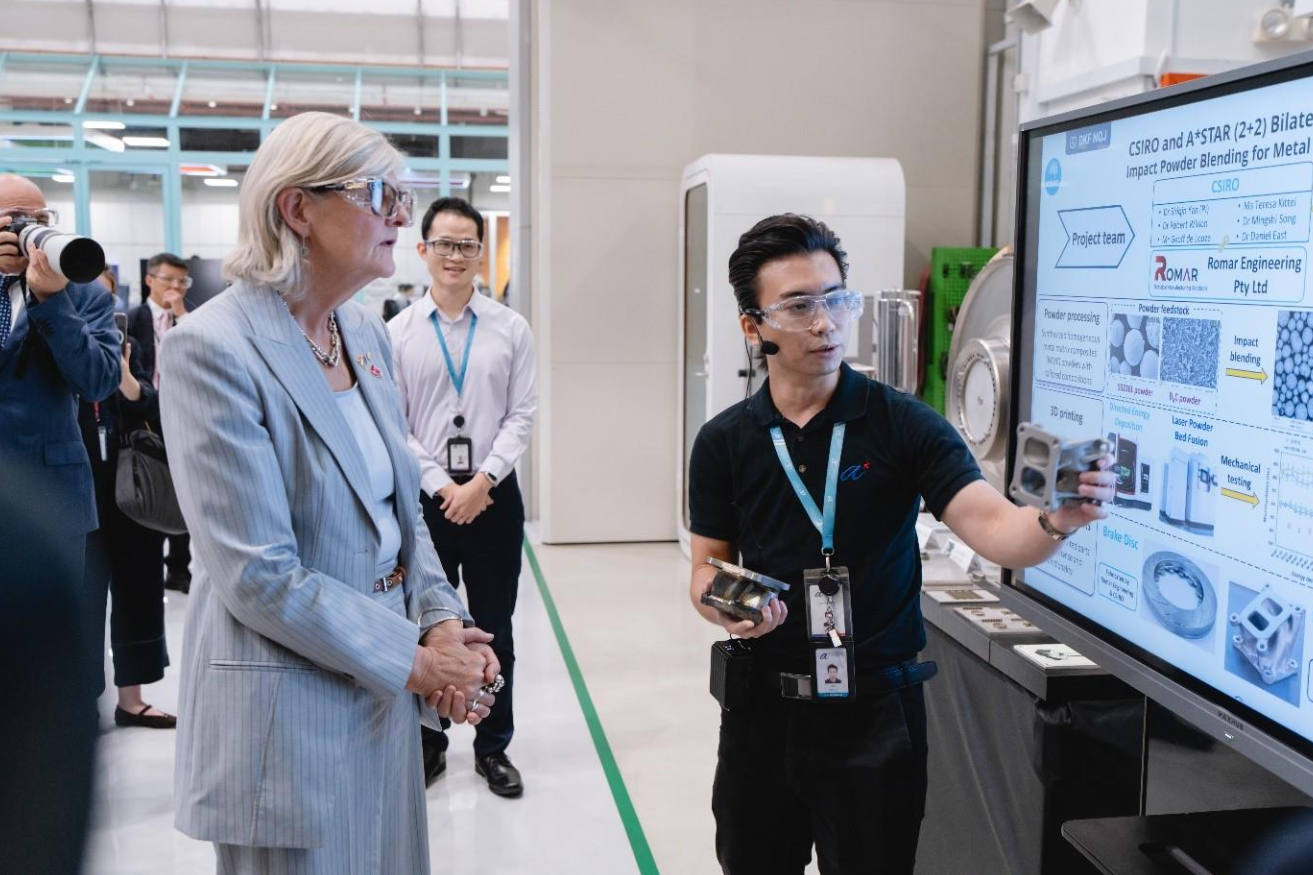
A flagship initiative under CSIRO’s Master Research Collaboration Agreement with A*STAR, the program addresses shared challenges critical to creating a greener economy and sustainable future.
The idea pairs two research teams with two industry collaborators, one from each country. This ‘power of pairs’ unlocks networks, funding, and advances applied research.
Revving to go: forging new compounds and connections
For Dr Robert Wilson, Principal Research Scientist at CSIRO, the A*STAR-CSIRO 2+2 Program offered an opportunity to push forward novel approaches in feedstock development additive manufacturing.
Additive manufacturing, or 3D printing, builds parts layer by layer from digital designs. Once focused mainly on single metal alloys, it can now incorporate multi-materials such as ceramic and metal powders together. The process is more complex, unless one can make a specialised composite powder (known as feedstock) to combine the best of both worlds. For example, ceramics add hardness, wear resistance, and thermal stability, while metals provide ductility and strength. The outcome is a kind of ‘super composite’ that reduces waste and enables the manufacturing of complex, precise components servicing industries such as aerospace, automotive, and healthcare.
“When manufacturing multi-material systems, you need to match the reactivity and compatibility of the materials and do so at high material yields and best component properties. The powders we make are not just a simple blend of powders; they are intimately mixed and combined at the particle level to produce a new composite powder. A simple blend segregates or becomes unmixed or is variable during 3D printing. Our powders do not segregate, their flows are improved, particle shape is improved, and composition is controlled. Because the powders do not segregate, the unused powder after each 3D print can be collected and used again and again in the 3D printing process, rather than thrown away as is common for simple blends.”
“For the first part, we focused on feedstock development by using a solid state milling process that has not been used for metals and ceramics before” Wilson said. “We didn’t invent the milling process itself, but CSIRO generated an extensive patent portfolio by inventing the innovative use of the process to combine metals and ceramics via unique methods and recipes into a single homogenous powder to tailor both the shape and composition of metal-ceramic powder combinations.
Partnering with ASTAR enabled the teams to harness their complementary strengths. As Wilson explained, “We developed the powder and the research team at ASTAR tested the 3D printing of it in their 3D printer.”
The 2+2 program offered a valuable platform to validate their concepts. “The 2+2 program provided an opportunity to prove our powders and let us put many of our theories to the test to realize prototype components and see how the market might respond,” he said.
Braking waste with next-gen motorcycle components
During the first stage, the teams from CSIRO and A*STAR focused on the requirements of their industrial partners to generate prototype motorcycle parts to test advanced metal-ceramic powders for high-stress, safety-critical components. Motorcycle discs, in particular, were ideal due to their relatively small size to print and demanding performance requirements, making them perfect for exploring durability, lifespan, and safety improvements.
Partnering with A*STAR combined research expertise with practical manufacturing experience, creating a distinctive approach to hybrid metal-ceramic composites. On the A*STAR side, the team 3D-printed an air intake, the component that draws air for combustion, using less material while maintaining peak performance. This demonstrated how additive manufacturing can produce lighter, stronger, and more efficient parts.
On the CSIRO side, Wilson and the CSIRO team worked with Romar Engineering to create a proof-of-concept motorcycle disc, aiming to improve durability, performance, and material efficiency. Wilson highlights the value of both the innovation and the collaboration “It was unique, nobody was really doing it quite this way. The novelty and practicality of the work was recognized,” he explained.
Wilson explains that the collaboration drew on the complementary strengths of each organisation: CSIRO’s materials expertise, A*STAR’s world-class research facilities, and Romar’s ability to design and manufacture at scale. “Through our long-standing collaborations with research institutions like CSIRO, we continue to push the frontier of additive methods, while keeping industrial scalability and IP integrity at the core.”
Advancing into Advanced Material Systems
In the second stage, the project moved beyond motorcycle parts to explore more complex materials, including nickel-based superalloys and ceramics. Additionally, Romar Engineering saw an opportunity: could the powders developed in the program improve the thermal dissipation and wear resistance of their injection molding dies?
Beyond immediate technical goals, the collaboration also advanced CSIRO’s long-term Intellectual Property strategy. “We’re building up our Intellectual Property portfolio for the purposes of licensing and commercialization … this program helped facilitated that,” Wilson said.
Wilson reflects on the broader value of the work: “It was seen as unique, something nobody was really doing in quite this way. The novelty, combined with practical outcomes, made it stand out.”
The program also fostered international connections. “It’s a good opportunity to meet people from a similar but overseas organization and leverage those connections to create something bigger than you could do alone.”
From making prototype motorcycle components to unlocking advanced material applications, the 2+2 Program demonstrates how advanced feedstock development and additive manufacturing can produce durable, high-performance parts while opening new pathways for sustainable manufacturing and global collaboration.