Exploring the Solar System? Don’t leave home without us
We have been supporting space missions since the 1960s with our radio telescopes receiving critical spacecraft data. We also manage communication stations on behalf of NASA and the European Space Agency.
Share
Most of us don't leave home without our mobile phones. How does a spacecraft or a rover keep in touch? On a very basic level, you need a transmitter and receiver at either end of the call. For space missions you need receivers around the globe to maintain a connection with spacecraft as the Earth rotates.
Your video or audio is here! ID: {FA0645A2-3797-4C8F-A0B4-95E60D5E5DB2}
Helping NASA explore the Solar System and beyond
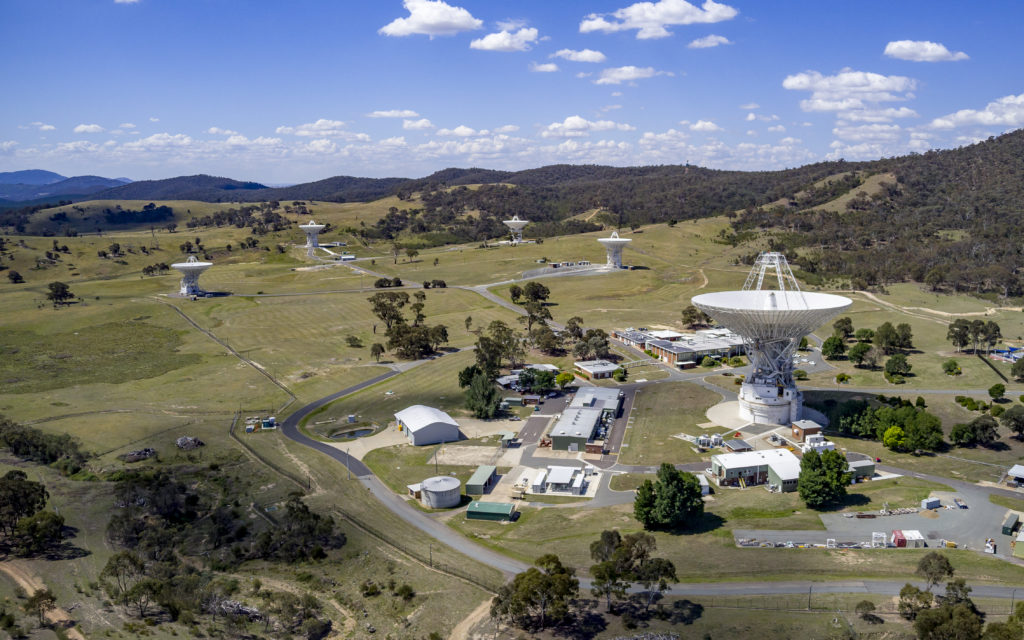
We have operated and managed NASA's Canberra Deep Space Communication Complex (CDSCC) since 2010. The complex is one of three that make up NASA's Deep Space Network, responsible for providing around-the-clock contact with more than 40 spacecraft, including missions to study Mercury, Mars, Jupiter, Saturn, Pluto, comets, the Moon and the Sun.
The sister complexes are located at Goldstone in California, USA, and near Madrid in Spain. The teams that operate the antennas rotate shifts across the 24 hour period, taking it in turns to operate the entire network during their daylight hours. This is referred to as 'Follow the Sun' operations.
There are four active antennas at the Canberra complex – one 70m and three 34m radio dishes that receive data from, and transmit commands to, spacecraft on deep space missions. A new 34m antenna is under construction and will increase the capacity of the Deep Space Network to support current and future spacecraft and the increased volume of data they produce.
Operating antennas for the European Space Agency
Since 2019, we have operated the European Space Agency's New Norcia ground station, 130km from Perth. Similar to NASA's Deep Space Network, ESA's Estrack network has three deep space stations – New Norcia, Cebreros in Spain, and Malargue in Argentina. The European Space Operations Centre in Darmstadt, Germany, remotely controls interplanetary and astronomy spacecraft and Earth-orbiting satellites via the Estrack network. In addition to tracking ESA missions, the network regularly provides support to NASA and other international space agencies.
Two 35m antennas at the station provide support to ESA's missions exploring our Solar System and observing our galaxy and Universe. They track mission locations, send control commands, and reliably receive scientific data gathered hundreds of millions of kilometres from Earth.
In addition to supporting ESA missions, the station provides tracking support to scientific and interplanetary missions operated by other space agencies like NASA and Japan's JAXA.
Using NNO2, its smaller, 4.5m diameter antenna, the New Norcia station also provides critical tracking services for Ariane, Soyuz and Vega launchers lifting off from Europe's Spaceport at Kourou, French Guiana.
Radio telescopes providing ground station services
We have been supporting space missions since 1962 when Murriyang, our Parkes radio telescope, tracked the first interplanetary space mission, Mariner 2, as it flew by the planet Venus.
Murriyang isn't the only CSIRO telescope to have supported space missions. In 1995, the Australia Telescope Compact Array (ATCA) tracked the Galileo Probe as it descended through the atmosphere of Jupiter.
With the increasing number of space missions, there are a growing number of commercial space companies establishing ground station networks to take the load off traditional deep space communication networks.
Intuitive Machines is one of several commercial companies contracted by NASA to lead robotic lunar missions under the agency's Commercial Lunar Payload Services (CLPS) initiative. Murriyang is part of Intuitive Machines' Space Data Network to support their lunar missions.
The first of these, IM-1, delivered NASA and commercial science experiments and technology demonstrations to the Moon's south polar region in 2024. Our team operating Murriyang provided crucial downlink support when their Odysseus lander came to rest at an angle significantly reducing its communication capabilities.
Your video or audio is here! ID: {7F4D64B4-1375-4FFE-AB6C-40A53C14C444}
Our radio telescopes are valuable for spacecraft tracking due to their large collecting area and advanced data acquisition systems. Operating as a ground station for space missions complements the astronomy research conducted with these telescopes and helps maintain these world-class research instruments.
Most of us don't leave home without our mobile phones. How does a spacecraft or a rover keep in touch? On a very basic level, you need a transmitter and receiver at either end of the call. For space missions you need receivers around the globe to maintain a connection with spacecraft as the Earth rotates.
[Music plays and an animation image appears of a spacecraft above a thick coloured line and then the image shows a hand holding a magnifying glass and moving along above the line]
Narrator: When we say we’re tracking a spacecraft that doesn’t mean we’re following it down the street to the shops.
[Animation image changes to show dotted lines appearing within the coloured line and text appears: Spacecraft tracking]
So, what does it mean?
[Camera zooms out to show people in front of a bank of computer screens displaying spacecraft data]
Tracking can involve several things, working out where the spacecraft is, receiving data from it and sending commands.
[Animation image changes to show a satellite dish against a night sky and then the camera zooms out to show a line linking from the satellite dish to the spacecraft and text appears: s = (t*c)/2]
We work out the spacecraft’s distance by sending it a radio message and having it reply straight away.
Animation image changes to show wavy lines linking the spacecraft to a world globe against a starry sky]
Radio waves travel at the speed of light so the time it takes to get the message back tells us how far away the spacecraft is. We learn the spacecraft’s position in the sky by measuring its angular distance from a known star or other object.
[Animation image shows the spacecraft in the night sky surrounded by various pictures depicting data being collected]
Spacecraft gather a lot of data.
[Animation image shows the data pictures rotating around the spacecraft and then disappearing and a stream of ones and zeros appear in a line behind the spacecraft]
This can be pictures or measurements of the temperature and pressure of a planet’s atmosphere, the strength of its gravity, or its magnetic field.
[Camera zooms out to show the lines of zeros and ones linking down to a satellite dish on the world globe]
The information is digitised into binary code, ones and zeros, then converted to radio waves, and beamed to earth.
[Animation image changes to show people in front of a bank of computer screens covered with ones and zeros and then the screens change to depict various data pictures on the screens]
Large dishes catch the weak signals. We turn the signals back into ones and zeros and then into a picture of whatever the original data was helping scientists make new discoveries.
[Animation image changes to show a satellite dish sending a line of ones and zeros up to a spacecraft in the sky and then the image shows the spacecraft changing direction]
Finally, some dishes can also transmit instructions to a spacecraft to adjust its course, take measurements, or turn instruments on and off.
[Animation image shows the spacecraft rotating in the sky and the image shows a purple coloured planet moving past the spacecraft]
Spacecraft are the eyes and ears we send out to explore the solar system and beyond. We track them to stay in touch so they know where to go, what to do, and when to send their discoveries back home.
[Image changes to show the CSIRO logo on a dark blue screen]
We have operated and managed NASA's Canberra Deep Space Communication Complex (CDSCC) since 2010. The complex is one of three that make up NASA's Deep Space Network, responsible for providing around-the-clock contact with more than 40 spacecraft, including missions to study Mercury, Mars, Jupiter, Saturn, Pluto, comets, the Moon and the Sun.
The sister complexes are located at Goldstone in California, USA, and near Madrid in Spain. The teams that operate the antennas rotate shifts across the 24 hour period, taking it in turns to operate the entire network during their daylight hours. This is referred to as 'Follow the Sun' operations.
There are four active antennas at the Canberra complex – one 70m and three 34m radio dishes that receive data from, and transmit commands to, spacecraft on deep space missions. A new 34m antenna is under construction and will increase the capacity of the Deep Space Network to support current and future spacecraft and the increased volume of data they produce.
Since 2019, we have operated the European Space Agency's New Norcia ground station, 130km from Perth. Similar to NASA's Deep Space Network, ESA's Estrack network has three deep space stations – New Norcia, Cebreros in Spain, and Malargue in Argentina. The European Space Operations Centre in Darmstadt, Germany, remotely controls interplanetary and astronomy spacecraft and Earth-orbiting satellites via the Estrack network. In addition to tracking ESA missions, the network regularly provides support to NASA and other international space agencies.
Two 35m antennas at the station provide support to ESA's missions exploring our Solar System and observing our galaxy and Universe. They track mission locations, send control commands, and reliably receive scientific data gathered hundreds of millions of kilometres from Earth.
In addition to supporting ESA missions, the station provides tracking support to scientific and interplanetary missions operated by other space agencies like NASA and Japan's JAXA.
Using NNO2, its smaller, 4.5m diameter antenna, the New Norcia station also provides critical tracking services for Ariane, Soyuz and Vega launchers lifting off from Europe's Spaceport at Kourou, French Guiana.
ESA's New Norcia ground station in Western Australia. Credit: ESA.
Radio telescopes providing ground station services
We have been supporting space missions since 1962 when Murriyang, our Parkes radio telescope, tracked the first interplanetary space mission, Mariner 2, as it flew by the planet Venus.
Murriyang isn't the only CSIRO telescope to have supported space missions. In 1995, the Australia Telescope Compact Array (ATCA) tracked the Galileo Probe as it descended through the atmosphere of Jupiter.
With the increasing number of space missions, there are a growing number of commercial space companies establishing ground station networks to take the load off traditional deep space communication networks.
Intuitive Machines is one of several commercial companies contracted by NASA to lead robotic lunar missions under the agency's Commercial Lunar Payload Services (CLPS) initiative. Murriyang is part of Intuitive Machines' Space Data Network to support their lunar missions.
The first of these, IM-1, delivered NASA and commercial science experiments and technology demonstrations to the Moon's south polar region in 2024. Our team operating Murriyang provided crucial downlink support when their Odysseus lander came to rest at an angle significantly reducing its communication capabilities.
[Music plays and an image appears of the buildings on the left as the camera pans right to the flags in the foreground of the Parkes radio telescope, and text appears: Music- Serge Pavkin , Murriyang, CSIRO’s Parkes radio telescope, Parkes Observatory, NSW, Australia, Wiradjuri Country]
[Image changes to show Brian Mader talking to the camera as he’s pointing to the Parks radio telescope, and text appears: Brian Mader, Mission Operations Engineer, Intuitive Machines]
Brian Mader: Sowe're here at Parkes with the Big Dish behind me.
[Image changes to show the Parkes radio telescope in the background as the camera pans down to focus on Brian talking with John Sarkissian and John Reynolds in the foreground]
This is one of the ground stations that we've used at Intuitive Machines as part of our LTN or Lunar Telemetry and Tracking network.
[Image changes to show a close view of the dish of the Parks radio telescope as the camera pans down to the base showing a rear view of Brian,John Sarkissian and John Reynolds walking to the Parks radio telescope]
It'sa number of ground stations that we've contracted with throughout the world to bring data back from the moon for our lunar lander missions.
[Image changes to show John Sarkissian, John Reynolds and Brian entering the Parks radio telescope, and image changes to show the focus cabin and supporting tripod structure above the telescope dish]
This is the biggest one in our network so the data rates are very nice, we’re able to bring down a lot of data on this one.
[Camera pans down showing more of the dish, and then the image changes to show John Sarkissian. talking to the cameraand spreading his arms out wide, and text appears: John Sarkissian, Operations Scientist, CSIRO]
John Sarkissian: Well, as you can see, we're standing on the surface of Murriyang, our Parkes radio telescope and you can see just why we call it the dish.
[Image changes to show the Parks radio telescope focus cabin and tripod structure over the dish again as the camera pans right]
It'sessentially abowl shaped antenna, 64m in diameter, which means it's extremely sensitive.
[Image changes to show John Sarkissian talking to the camera, and then the image changes to show buildings and flags on the right as the camera pans left to the Parks radio telescope]
Because of that, our telescope can downlink in just two or three days the equivalent amount of data that a smaller antenna would take a week or two to do.
[Image changes to show Brian listening to John Reynolds talking and pointing at the details for ‘Operation Mode’ on a computer screen]
John Reynolds: It’s tremendously exciting to be part of the return to lunar exploration, and working with our colleagues on intuitive Machines has been an absolute pleasure.
[Camera zooms in on John Reynolds’s hand pointing at the computer screen, and then the image changes to show John Reynolds talking to the camera, and text appears: John Reynolds, Facilities Program Director, CSIRO]
Fortunately, we have a little bit of experience in the space tracking business going back right to the earliest days of the telescope.
[Image changes to show footage of astronauts raising a flag beside a rocket on the Moon,and then the image changes to show footage of colleagues looking at a rocket Moon landing blueprint, and text appears top right: Credit- NASA, Credit- Australian Information Service]
And most folks will remember something about Apollo 11, which was, I guess, the crowning glory of our involvement in space tracking.
[Image changes to show footage of a hand using the pointer finger to trace the path on the rocket Moon landing blueprint, and then the image changes to show footage of two males talking inside a control room]
But that's just one of many, many occasions where we work with NASA. We've also worked with ESA in the past.
[Image changes to show John Reynolds talking to the camera, and then the image changes to show top of the dish of the Parkes radio telescope as the camera pans down]
So in a sense, this is what we do in addition to all the world class radio astronomy research that we do.
[Image changes to show Brian talking to the camera]
Brian Mader: Murriyang brings a few things that are very unique.
[Image changes to show a view of the rear of the dish and the camera pans upwards to the top]
One just by the size of it, it'sa very large ear.
[Image changes to show John Reynolds talking to the camera, and then the image changes to show a side view of the Parkes radio telescope with flags in the foreground]
John Reynolds: It's the only large single dish radio telescope in the southern hemisphere, so a large fraction of the sky, if you want to look at it with a single big dish, you've got to come to Parkes.
[Image changes to show a split screen with views of a round table at the centre of a round room as colleagues use screens lining the walls,and image changes to show Brian talking to the camera, and text appears: Credit- NASA/Intuitive Machines]
Brian Mader:On our first mission, IM-1, our lander basically tipped over sideways after landing, and the antennas on the lander were not pointed directly at earth. So the signal that was coming from the moon was not pointed where it should have been.
[Image changes to show a blue sky with the sun shining at the top as the camera pans down to the dish where John Sarkissian, John Reynolds and Brian are talking together]
This was the only dish in our network that could, that could hear the signal.
[Image changes to show Brian listening to John Sarkissian talking, and then the image changes to show John Sarkissian talking to the camera]
John Sarkissian: We were able to receive those extremely feeble signals and relay them back to Intuitive Machines in Houston. They were able to to to downlink data from that spacecraft, which otherwise they may not have been able to do.
[Image changes to show John Sarkissian talking as the camera pans right to show John Reynolds and Brian listening as they are gathered on the dish]
It was really great that the CSIRO was involved in that, and we were able to do our bit to ensure the success of the mission.
[Image changes to show Brian talking to the camera]
Brian Mader: With one mission under our belt, so to speak, we're able to learn from that, right?
[Images move through to show a‘Delicate Unit’, views of Brian listening to John Sarkissian talking, and then a camera view simulation of a moon approach on the computer screen,and text appears: Credit- Intuitive Machines]
So we saw things that worked well, we saw things that didn't work well and we're able to adapt and, and take the the best things and keep doing those and improve on what we didn’t. During the transit phase we need to figure out where the spacecraft is.
[Image changes to show Brian talking to the camera]
So we do tracking data and then also telemetry to monitor the vehicle and any payloads, any scientific data that's coming down.
[Image changes to show a simulation of ‘Odysseus’ landing on the moon with a control room inset bottom right, and text appears top right: Credit NASA/Intuitive Machines]
Once we land on the surface of the moon, it's a lot of scientific data that we're bringing down with the experiments.
[Image changes to show John Reynolds talking to the camera]
John Reynolds: In a sense, it's not that technically difficult. We, we find that the activities of space tracking and radio astronomy are quite similar in principle, a lot of the instrumentation is the same.
[Image changes to show Brian talking with John Sarkissian on the dish]
A lot of the techniques are the same, so it's a bit of a natural fit.
[Image changes to show colleagues assembled at the centre of the dish, and image changes to show part of the tripod structure as the camera pans down to John Sarkissian and Brain talking and looking up to the top]
Brian Mader: There's things that, you know, somebody that operates the dish on a day to day basis might pick up on, little nuances of how the signal is coming in, for example. That is very helpful to us as operators.
[Image changes to show John Reynolds talking to the camera]
John Reynolds: The telescope behind me turned 60, can you believe it, a couple of years ago, 60 years. And yet it's still performing on the front line of scientific research. And why is that?
[Image changes to show an aerial view of the Parkes radio telescope when it was young and the camera pans left]
It's because of the technology behind the, the dish itself.
[Image changes to show a male standing on the dish as the camera pans left]
The dish was incredibly well built in the first place and it's survived.
[Images move through to show a female using monitor screens, a close view of her hands typing on the keyboard, and then a rear view of the female working at the monitor screens]
But it's the electronics, it's the sensitive receivers, it's the digital processing, it's the computing.
[Image changes to show John Reynolds talking to the camera, and then the image changes to show a hand adjusting dials on the oscilloscope]
All of these things have transformed themselves time and time again in that 60 years, to the point where the telescope is now hundreds of thousands of times more sensitive than it was when it was originally built.
[Image changes to show Brian talking to the camera]
Brian Mader: We just, we’re looking forward to continuing to expand our partnerships with organisations like CSIRO and and just continue to make things bigger and better for the future.
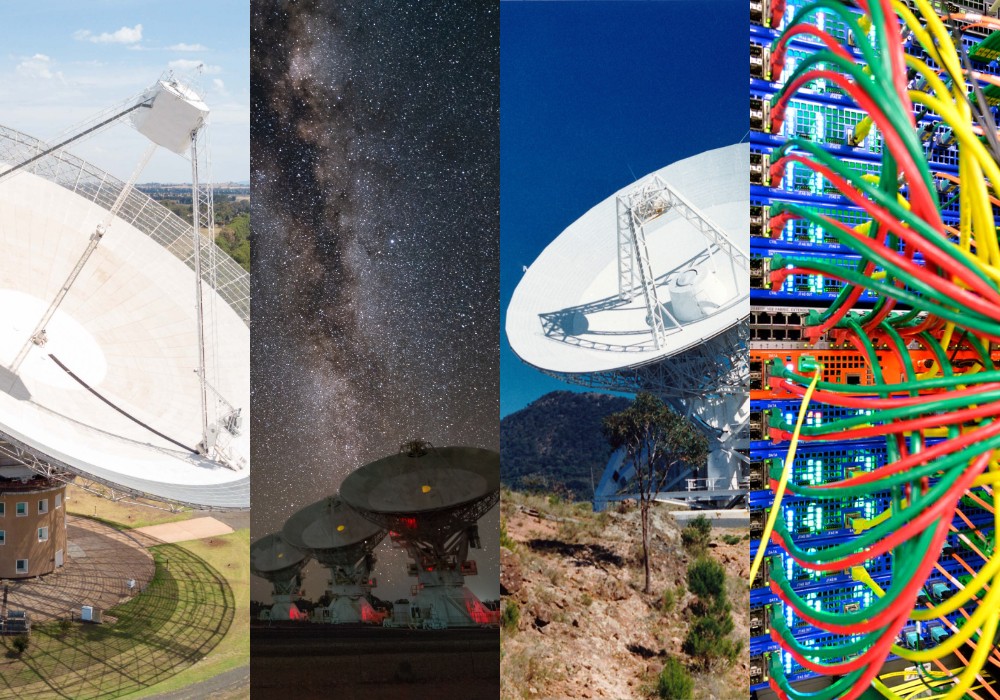
Our radio telescopes are valuable for spacecraft tracking due to their large collecting area and advanced data acquisition systems. Operating as a ground station for space missions complements the astronomy research conducted with these telescopes and helps maintain these world-class research instruments.
Our radio telescopes can also provide downlink services for space missions.
Contact us
Find out how we can help you and your business. Get in touch using the form below and our experts will get in contact soon!
CSIRO will handle your personal information in accordance with the Privacy Act 1988 (Cth) and our Privacy Policy.
We have received your enquiry and will reply soon.
We're Sorry
The contact form is currently unavailable. Please try again later. If this problem persists, please call us with your enquiry on 1300 363 400 or +61 3 9545 2176. We are available from 9.00 am to 4.00 pm AEST Monday - Friday.