
CSIRO's Industry PhD program supports a three-way partnership training new researchers in critical areas and facilitate long-term collaboration between research organisations and industry.
Expressions of interest
Our 2026 intakes have closed. For our 2027 expression of interest intakes, the primary round will open on 1 February and close on the 2 April. Our secondary round will open 3 May and close on the 6 August. For EOIs submitted in 2027, projects are expected to start late 2027/early 2028.
If you are a CSIRO researcher who has a project idea, please contact us to start the conversation!
Program benefits
Develop new, or strengthen relationships with industry partners and universities to:
- upskill PhD students to develop capability in CSIRO priority areas and in areas of national need
- build consortia aligned with CSIRO Research Units through iPhD projects
- grow industry and university involvement with CSIRO exploratory research
- provide PhD students with industry-focused training.
Program funding and support
Funding each year consists of three components:
- Student scholarship which comprises:
- CSIRO Industry PhD Scholarship provided by the Government (indexed at 3% annually)
- Industry top-up provided by the industry partner.
- Project Expense and Development package provided by the Government for research operating costs and the student’s research skill development.
- Student career and professional development training funded by the Government and delivered by iPhD program staff alongside the student's PhD.
| For students commencing in 2028 | Total scholarship | CSIRO Industry PhD Scholarship | Industry top-up | Project Expense and Development package |
|---|---|---|---|---|
| First year of project | $50,998 | $38,267 | $12,731 | $13,792 |
| Second year of project | $52,528 | $39,415 | $13,113 | $14,205 |
| Third year of project | $54,104 | $40,598 | $13,506 | $14,632 |
| Fourth year of project | $55,727 | $41,816 | $13,911 | $15,071 |
Program requirements
iPhD projects must:
- align with CSIRO and Government priorities
- address an industry problem while complying with the university PhD requirements
- be with an Australian industry partner or an industry partner with an Australian presence
- be limited to domestic students, that is, Australian Permanent Residents, Australian Citizens, and New Zealand Citizens
- be up to four years duration
- include at least 60 workdays of project related activities under the guidance of the industry partner, which is referred to as the Industry Engagement component.
CSIRO Research Units must:
- provide a suitably experienced researcher to supervise the PhD student
- provide access to facilities and infrastructure, if required
- fund CSIRO supervisor travel, accommodation and ancillary expenses, if required
- fund the affiliate access charge after the first year of the PhD. If ongoing access to CSIRO systems, facilities and infrastructure is required after the first year, the Research Unit must cover this cost.
Project development stages
Expressions of Interest (EOI) are accepted from early February each year.
Intakes will be divided into two rounds:
- primary round opening 1 February, closing 2 April 2027 to support approximately 30 new projects
- secondary round opening 3 May, closing 6 August 2027 to support approximately 20 new projects.
For EOI's submitted in 2027, projects are expected to start late 2027/early 2028.
Expression of interest (EOI) process
University, industry and CSIRO supervisors must complete the online EOI form on the iPhD submission portal collaboratively.
- The leading party (university, CSIRO or industry) will need to register an account.
- The leading party will then need to invite the other parties to register an account to join the online form.
- Each party must upload evidence of support from their approving delegate. For CSIRO supervisors, we encourage you to use our optional template to help communicate program requirements to obtain approval.
For further information on how to use the online submission portal, watch our video or download our written guide and read-only EOI form.
Access the online submission portal
EOIs must meet program eligibility requirements and will be evaluated against assessment criteria. Please refer to our Program Rules for further information.
If successful, a Collaboration Agreement will be executed between the involved parties, and the project is then advertised for a student via the participating university.
Program resources
Key documents and links
- Program Rules
- Program Rules
- Online submission portal
- Read-only EOI form
- Read-only EOI form
- Approval template for EOI submission for CSIRO researchers
- How to lodge an online EOI video
- How to lodge an online EOI written guide
- How to lodge an online EOI written guide
Promotional materials
- Webinar recording 2026 (Expression of Interest process) - 13 mins
- CSIRO researcher brochure
- CSIRO researcher brochure
CSIRO's Industry PhD program supports a three-way partnership training new researchers in critical areas and facilitate long-term collaboration between research organisations and industry.
Expressions of interest
Our 2026 intakes have closed. For our 2027 expression of interest intakes, the primary round will open on 1 February and close on the 2 April. Our secondary round will open 3 May and close on the 6 August. For EOIs submitted in 2027, projects are expected to start late 2027/early 2028.
If you are a CSIRO researcher who has a project idea, please contact us to start the conversation!
Program benefits
Develop new, or strengthen relationships with industry partners and universities to:
- upskill PhD students to develop capability in CSIRO priority areas and in areas of national need
- build consortia aligned with CSIRO Research Units through iPhD projects
- grow industry and university involvement with CSIRO exploratory research
- provide PhD students with industry-focused training.
Program funding and support
Funding each year consists of three components:
- Student scholarship which comprises:
- CSIRO Industry PhD Scholarship provided by the Government (indexed at 3% annually)
- Industry top-up provided by the industry partner.
- Project Expense and Development package provided by the Government for research operating costs and the student’s research skill development.
- Student career and professional development training funded by the Government and delivered by iPhD program staff alongside the student's PhD.
| For students commencing in 2028 | Total scholarship | CSIRO Industry PhD Scholarship | Industry top-up | Project Expense and Development package |
|---|---|---|---|---|
| First year of project | $50,998 | $38,267 | $12,731 | $13,792 |
| Second year of project | $52,528 | $39,415 | $13,113 | $14,205 |
| Third year of project | $54,104 | $40,598 | $13,506 | $14,632 |
| Fourth year of project | $55,727 | $41,816 | $13,911 | $15,071 |
Program requirements
iPhD projects must:
- align with CSIRO and Government priorities
- address an industry problem while complying with the university PhD requirements
- be with an Australian industry partner or an industry partner with an Australian presence
- be limited to domestic students, that is, Australian Permanent Residents, Australian Citizens, and New Zealand Citizens
- be up to four years duration
- include at least 60 workdays of project related activities under the guidance of the industry partner, which is referred to as the Industry Engagement component.
CSIRO Research Units must:
- provide a suitably experienced researcher to supervise the PhD student
- provide access to facilities and infrastructure, if required
- fund CSIRO supervisor travel, accommodation and ancillary expenses, if required
- fund the affiliate access charge after the first year of the PhD. If ongoing access to CSIRO systems, facilities and infrastructure is required after the first year, the Research Unit must cover this cost.
Project development stages
Expressions of Interest (EOI) are accepted from early February each year.
Intakes will be divided into two rounds:
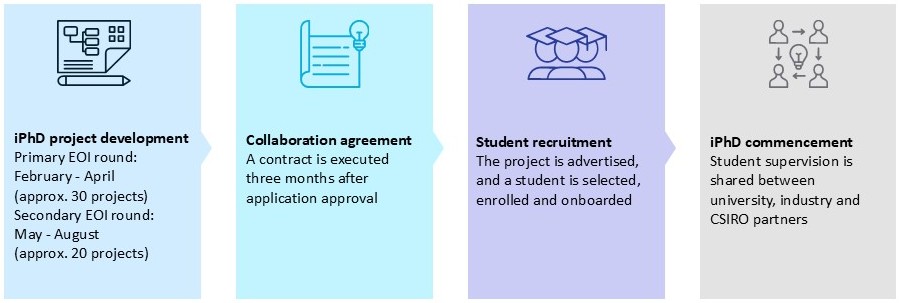
- primary round opening 1 February, closing 2 April 2027 to support approximately 30 new projects
- secondary round opening 3 May, closing 6 August 2027 to support approximately 20 new projects.
For EOI's submitted in 2027, projects are expected to start late 2027/early 2028.
Expression of interest (EOI) process
University, industry and CSIRO supervisors must complete the online EOI form on the iPhD submission portal collaboratively.
- The leading party (university, CSIRO or industry) will need to register an account.
- The leading party will then need to invite the other parties to register an account to join the online form.
- Each party must upload evidence of support from their approving delegate. For CSIRO supervisors, we encourage you to use our optional template DOCX (55 KB) to help communicate program requirements to obtain approval.
For further information on how to use the online submission portal, watch our video or download our written guide PDF (344 KB) and read-only EOI form PDF (934 KB).
Access the online submission portal
EOIs must meet program eligibility requirements and will be evaluated against assessment criteria. Please refer to our Program Rules PDF (642 KB) for further information.
If successful, a Collaboration Agreement will be executed between the involved parties, and the project is then advertised for a student via the participating university.
Infographic explaining the project development stages and approximate timeframes of the CSIRO Industry PhD Program. PhD project development Collaboration agreement Student recruitment iPhD commencement
Program resources
Key documents and links
- Program Rules PDF (642 KB)
- Program Rules TXT (52 KB)
- Online submission portal
- Read-only EOI form PDF (934 KB)
- Read-only EOI form TXT (8 KB)
- Approval template for EOI submission for CSIRO researchers DOCX (55 KB)
- How to lodge an online EOI video
- How to lodge an online EOI written guide PDF (344 KB)
- How to lodge an online EOI written guide TXT (8 KB)
Promotional materials
- Webinar recording 2026 (Expression of Interest process) - 13 mins
- CSIRO researcher brochure PDF (530 KB)
- CSIRO researcher brochure TXT (3 KB)
FAQ: CSIRO researcher
A collaboration agreement is established between CSIRO, the university and industry partner, which highlights the intellectual property (IP) arrangement. Any specific IP considerations should be identified during the scoping of the project and detailed in the EOI application so the parties can discuss further and provide feedback during the contract negotiation stage. Under all circumstances, students will own the copyright to their thesis. Project publications should be encouraged, but some conditions may be imposed to protect Project IP and confidential information of the parties involved.
Students must be sought through an open advertising process facilitated by the involved university. Student expressions of interest will need to be lodged via the university website or supervisor and the supervisory panel will shortlist, interview, and nominate the most suitable student to formally apply for the scholarship. If you are approached by a prospective student during the EOI phase who has a project idea, you must drive the application with the other partners without involvement from the student. The project advertising and student recruitment processes explained above will still need to be followed.
iPhD program staff are responsible for the delivery of the CSIRO Industry PhD program and support all project development stages, including expression of interest, contracting and student recruitment processes. As the funding administrator, we distribute the student scholarship and project expenses funds to the appropriate partners. Program staff also develop a tailored student career and professional development training program, which is delivered alongside the PhD program. Program staff actively support students and contributing partners and act as the first point of call should any issues arise.
The program’s three-way partnership calls for the appointment of a university supervisor/s, an industry supervisor, and a CSIRO supervisor. Each supervisor will be responsible for certain aspects of the student’s supervision. However, the Primary Supervisor, allocated from the university, is responsible for monitoring and assessing the PhD student progress in accordance with the university’s PhD academic requirements. A tailored project management and communication plan should be created prior to project commencement, detailing supervisor roles, level of commitment and communication methods so the student can access appropriate support.
Funding is provided each year to the supervising organisation where the student is primarily based to cover project operating expenses and development activities. Project expenses may include lab consumables, fieldwork, and other research costs. Student travel costs associated with the project and/or approved development activities are also eligible expenses.
The Project Expense and Development package cannot be used to fund items such as supervisor travel costs, professional association membership fees, wages or retrospective costs.
Projects must be allocated a primary location by the supervisory panel. This location is where the student will be primarily based to undertake the project. The primary location must be in Australia and may be at the host university, at CSIRO or on the industry partner’s premises. The location of the three-month Industry Engagement Component may be different to the project’s primary location.
iPhD program staff assist with project scoping, partner communication, and support the submission of the formal EOI paperwork. If required, iPhD program staff will make best endeavours to locate eligible partners which have complementary and relevant knowledge and experience.
All submitted EOIs will be assessed against evenly weighted criterion. iPhD staff may consult with CSIRO research leaders for guidance. Applicants may be asked to provide more information and/or discuss their EOI with iPhD program staff. The selection criteria will assess:
- Industry experience provided to the student
- Project impact
- Alignment to Government and CSIRO priorities
- Research industry collaboration
- Project feasibility and resources
For further information, please refer to our Program Rules PDF (642 KB).
There is a strong preference for private for-profit industry partners, particularly in the Small to Medium Enterprise sector. However, Government and not-for profit entities where an industry relevant experience can be provided to the student are able to participate. Government entities must be Body Corporates (Non-Corporate Commonwealth Entities are not eligible). For further information, please visit the Department of Finance website.
Non-standard payment arrangements are strongly discouraged. Any alternative funding arrangements must be approved by the iPhD team and University prior to EOI submission. Such arrangements will only be approved in exceptional circumstances.
Students receive a structured professional development package delivered by CSIRO alongside the PhD. This package will help foster the student’s professional skills including leadership, entrepreneurship and innovation. Most training will be delivered online, however there will be some in-person events. The professional development training is mandatory and requires a time commitment of approximately five days per year.
The Industry Engagement Component is a requirement of the CSIRO Industry PhD program. It aims to ensure that the needs of industry guide the development, activities, and outcomes of the PhD project. It provides an opportunity for the student to work under the guidance of their industry partner on research and development activities contributing to their PhD project.
Activities should provide students with relevant tools and experience to better contextualise and apply research in an industry setting. Activities should contribute to the development, research and outcomes of the larger PhD project, and be related to the student’s area of research. Potential activities may include:
- understanding the research needs of the industry partner and/or the broader industry
- undertaking practical research translation activities under the guidance of the industry partner
- testing research assumptions and innovations in an industry setting with end-users.
Generally, any results from these activities can be included in the thesis so long as confidentiality and publication clauses listed in the Collaboration Agreement and Student Agreement are complied with.
The Industry Engagement Component must be a minimum of 60 full-time days or three calendar months in duration and should ideally take place at the industry partner’s premises. However, activities can be undertaken remotely, within reason. A mixture of online and in-person engagement is also acceptable. The Industry Engagement Component should ideally be completed part-time or in short blocks, strategically placed throughout the PhD to encourage ongoing engagement between the industry partner and the student.
At the discretion and with the agreement of the supervisory team, alternate locations may be possible, but the university will need to approve any alternate location(s).
Examples of locations include:
- CSIRO site
- the university
- a combination of sites
- remote
- a mixture of remote and in-person attendance.