
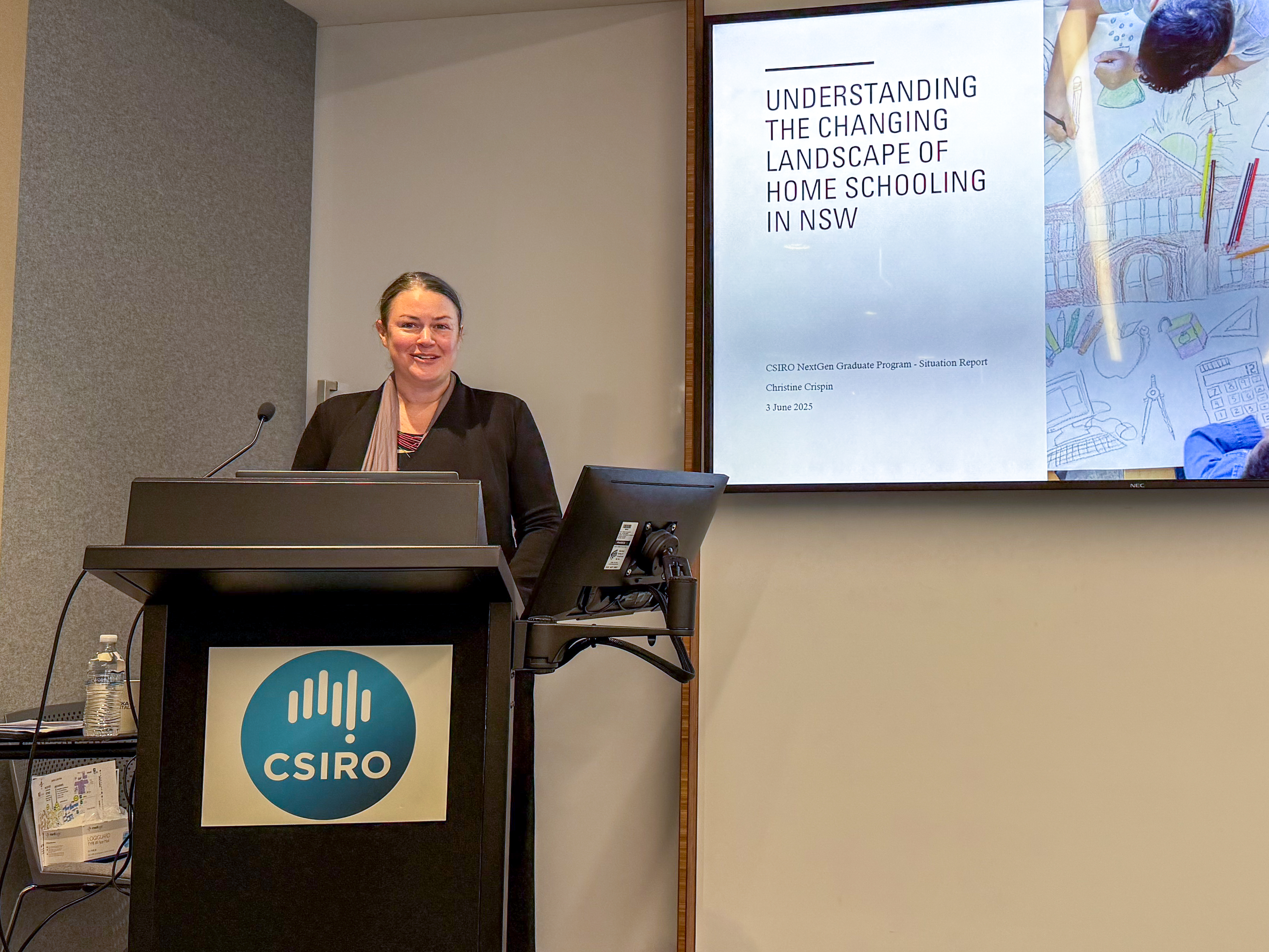
 When Christine (Chrissie) Crispin started looking into school disengagement and home schooling in New South Wales as part of her PhD, she expected data to be limited. What she didn't expect was how many doors it would open.
Home schooling accounts for around one per cent of school-aged children in NSW, a small share, but one that grew sharply between 2019 and 2024. A 2025 NSW Auditor-General's report found significant increases in home-schooled students with disability, those from lower socioeconomic backgrounds, and Aboriginal students. More than half had previously been in the public system.
Understanding who these students are and what they need, is not straightforward. Many are difficult to track across national datasets, leaving gaps in the evidence used to understand educational outcomes.
That's the problem Chrissie set out to understand. And it's one she may not have been able to tackle without CSIRO's Next Generation Graduates Program (NGGP).
Bringing a different lens
Chrissie came to her PhD with more than 15 years in social impact consulting, and a personal stake in the question. As a parent of a neurodivergent child, she had navigated firsthand how challenging education can be, even with support.
What she didn't have was a background in data science. That's where NGGP changed what was possible.
"The coursework was incredibly relevant," she says. "I can't imagine how I would have accessed that learning any other way without doing another degree."
Through the program, she worked alongside data scientists and built the technical foundations to apply AI and machine learning to social research, something she describes as "pretty groundbreaking" for a field that has traditionally relied heavily on qualitative tools. The interdisciplinary environment of the Thrive initiative added another layer, with computer scientists and social researchers learning from each other in both directions.
But skills alone wouldn't have been enough. To research a population not as visible in the data, she needed to better understand the systems where that data is produced.
The placement that opened the door
Through NGGP, Chrissie undertook a placement with the NSW Department of Education's Home Schooling Directorate, arriving mid-transition as responsibility for regulating home schooling shifted from the NSW Education Standards Authority (NESA) to the Department.
"It was a busy time of change for us," says Katherine Lowing, her supervisor at the Department. "But we looked at Chrissie's background and thought she would have real value for us."
She did. Chrissie helped build the Directorate's stakeholder engagement framework with a community that had long been sceptical of the regulator. Being introduced as a Thrive researcher with her own lived experience turned out to be an asset.
"She wasn't seen as being one of us," Katherine says. "And that actually served a really important purpose in helping to build trust."
The shift was tangible. "I think it has accelerated the process," Katherine says. "It has sped up that building of relationship enormously." Stakeholders who had previously kept their distance were now reaching out directly. "It has acted as such a valuable bridge."
The placement also unlocked data access that would otherwise have been difficult to obtain. "Because of the connection with us, she could go through the process to get access to the information she would require," Katherine explains. "If she hadn't come to us, it may have been more difficult."
For the Department, the foundation Chrissie helped lay will matter well beyond the placement itself, with significant community co-design work ahead that will rely on the relationships now being rebuilt.
"We could do something that probably we wouldn't have been able to do without her," Katherine says. "It was an incredibly valuable experience."
What comes next
Chrissie's goal is simple: making students more visible in the data, and in the decisions that shape their education.
In practical terms, that means developing an evidence base that both policymakers and advocacy groups can actually use. For the many home-schooling organisations run by volunteers, stronger evidence could meaningfully support their advocacy, helping them make the case for resources, recognition, and change.
For government, it could contribute to a more nuanced understanding of who these families are and what they need, informing how home schooling is regulated and supported going forward.
The use of machine learning methods may be constrained by current data limitations, but Chrissie sees that as a challenge to work through, not a ceiling. The longer-term opportunity lies in reshaping what questions can be asked and answered as better data becomes available and trust between community and government slowly grows.
"The knowledge, the insights and the potential for me as a researcher to grow and extend the way I do research, that's the most exciting opportunity I see coming out of participating in NGGP."
That potential doesn't exist in isolation. It was built through the structure, relationships and training that NGGP made possible. Without it, this research probably doesn't happen in this form. The program gave Chrissie the technical training, the industry placement, and the connections to pursue research she couldn't have done any other way.
For home-schooled students across NSW, that growing evidence base matters.
When Christine (Chrissie) Crispin started looking into school disengagement and home schooling in New South Wales as part of her PhD, she expected data to be limited. What she didn't expect was how many doors it would open.
Home schooling accounts for around one per cent of school-aged children in NSW, a small share, but one that grew sharply between 2019 and 2024. A 2025 NSW Auditor-General's report found significant increases in home-schooled students with disability, those from lower socioeconomic backgrounds, and Aboriginal students. More than half had previously been in the public system.
Understanding who these students are and what they need, is not straightforward. Many are difficult to track across national datasets, leaving gaps in the evidence used to understand educational outcomes.
That's the problem Chrissie set out to understand. And it's one she may not have been able to tackle without CSIRO's Next Generation Graduates Program (NGGP).
Bringing a different lens
Chrissie came to her PhD with more than 15 years in social impact consulting, and a personal stake in the question. As a parent of a neurodivergent child, she had navigated firsthand how challenging education can be, even with support.
What she didn't have was a background in data science. That's where NGGP changed what was possible.
"The coursework was incredibly relevant," she says. "I can't imagine how I would have accessed that learning any other way without doing another degree."
Through the program, she worked alongside data scientists and built the technical foundations to apply AI and machine learning to social research, something she describes as "pretty groundbreaking" for a field that has traditionally relied heavily on qualitative tools. The interdisciplinary environment of the Thrive initiative added another layer, with computer scientists and social researchers learning from each other in both directions.
But skills alone wouldn't have been enough. To research a population not as visible in the data, she needed to better understand the systems where that data is produced.
The placement that opened the door
Through NGGP, Chrissie undertook a placement with the NSW Department of Education's Home Schooling Directorate, arriving mid-transition as responsibility for regulating home schooling shifted from the NSW Education Standards Authority (NESA) to the Department.
"It was a busy time of change for us," says Katherine Lowing, her supervisor at the Department. "But we looked at Chrissie's background and thought she would have real value for us."
She did. Chrissie helped build the Directorate's stakeholder engagement framework with a community that had long been sceptical of the regulator. Being introduced as a Thrive researcher with her own lived experience turned out to be an asset.
"She wasn't seen as being one of us," Katherine says. "And that actually served a really important purpose in helping to build trust."
The shift was tangible. "I think it has accelerated the process," Katherine says. "It has sped up that building of relationship enormously." Stakeholders who had previously kept their distance were now reaching out directly. "It has acted as such a valuable bridge."
The placement also unlocked data access that would otherwise have been difficult to obtain. "Because of the connection with us, she could go through the process to get access to the information she would require," Katherine explains. "If she hadn't come to us, it may have been more difficult."
For the Department, the foundation Chrissie helped lay will matter well beyond the placement itself, with significant community co-design work ahead that will rely on the relationships now being rebuilt.
"We could do something that probably we wouldn't have been able to do without her," Katherine says. "It was an incredibly valuable experience."
What comes next
Chrissie's goal is simple: making students more visible in the data, and in the decisions that shape their education.
In practical terms, that means developing an evidence base that both policymakers and advocacy groups can actually use. For the many home-schooling organisations run by volunteers, stronger evidence could meaningfully support their advocacy, helping them make the case for resources, recognition, and change.
For government, it could contribute to a more nuanced understanding of who these families are and what they need, informing how home schooling is regulated and supported going forward.
The use of machine learning methods may be constrained by current data limitations, but Chrissie sees that as a challenge to work through, not a ceiling. The longer-term opportunity lies in reshaping what questions can be asked and answered as better data becomes available and trust between community and government slowly grows.
"The knowledge, the insights and the potential for me as a researcher to grow and extend the way I do research, that's the most exciting opportunity I see coming out of participating in NGGP."
That potential doesn't exist in isolation. It was built through the structure, relationships and training that NGGP made possible. Without it, this research probably doesn't happen in this form. The program gave Chrissie the technical training, the industry placement, and the connections to pursue research she couldn't have done any other way.
For home-schooled students across NSW, that growing evidence base matters.