
Download the paper
Evolution of genetic technology in Australian crops
Australia marks 30 years of commercial agricultural gene technology in 2026. Over the past three decades, genetically modified (GM) crops have been steadily integrated into farming systems, supported by robust national regulation, coordinated stewardship and ongoing R&D. Australia's GM crops have built a strong safety record, with no confirmed adverse health or environmental impacts.
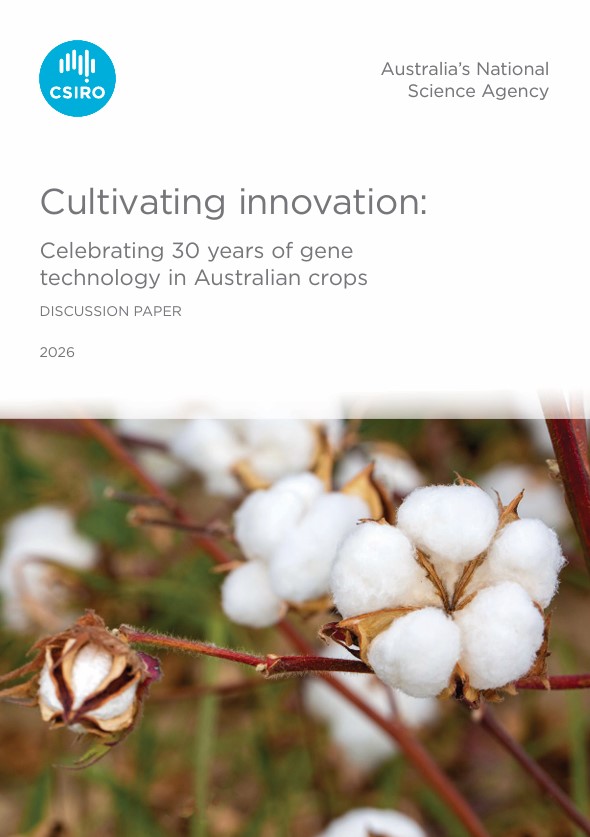
The discussion paper "Cultivating innovation: Celebrating 30 years of gene technology in Australian crops" highlights that clear market demand and consumer acceptance, coupled with tangible benefits for growers, environment and consumers were key drivers for uptake, even as industries navigated evolving regulatory settings both in Australia and international. The commercial adoption of GM cotton in 1996 is a major success story for Australia demonstrating that when GM technologies delivered a clear, practical value and aligned with existing farming systems and markets, they have become deeply integrated.
Over time, GM applications have expanded from pest and weed management to value adding traits, including crops designed for specialised oils and emerging molecular farming uses. Today, six GM crops have been approved in Australia: cotton, canola, banana, safflower, Indian mustard, and purple tomatoes.
Lessons to support future adoption
Australia's GM crop experience makes one message clear: future adoption will succeed only when strong policy settings, market confidence, grower value, stewardship and supply chain readiness work together and not in isolation. These elements have consistently underpinned successful uptake and remain essential as Australia considers the next generation of GM and gene edited crops.
Four critical lessons to guide future adopters:
- Clear, coherent policy settings are critical to enabling adoption at scale.
- Adoption is strongest where growers can clearly see and capture economic value.
- Adoption is enabled when stewardship is matched by commercial and supply-chain readiness.
- Innovation is most compelling when it is locally relevant and delivered as a sustained pipeline.
The next step is to apply these lessons to enable the next wave of adoption.
Enabling the next wave of GM adoption
The discussion paper outlines key impacts and lessons from Australia's experience with GM crop use and has framed the critical questions that will shape the next phase of adoption. It highlights the need to move from reflection to coordinated, forward-looking action.
CSIRO sees a clear opportunity to develop a coordinated national plan, linking research priorities, industry capability, commercialisation pathways and market readiness to turn emerging genetic technologies into tangible outcomes for Australian agriculture. Collaboration across government, industry and research will be essential to remove adoption barriers, unlock value, and position Australia to benefit from the next generation of advanced breeding technologies.
CSIRO welcomes engagement from government, industry and research partners interested in shaping the next phase of planning and action.
Read the Gene Technology Discussion Paper
Download the paper
Evolution of genetic technology in Australian crops
Australia marks 30 years of commercial agricultural gene technology in 2026. Over the past three decades, genetically modified (GM) crops have been steadily integrated into farming systems, supported by robust national regulation, coordinated stewardship and ongoing R&D. Australia's GM crops have built a strong safety record, with no confirmed adverse health or environmental impacts.
The discussion paper "Cultivating innovation: Celebrating 30 years of gene technology in Australian crops" highlights that clear market demand and consumer acceptance, coupled with tangible benefits for growers, environment and consumers were key drivers for uptake, even as industries navigated evolving regulatory settings both in Australia and international. The commercial adoption of GM cotton in 1996 is a major success story for Australia demonstrating that when GM technologies delivered a clear, practical value and aligned with existing farming systems and markets, they have become deeply integrated.
Over time, GM applications have expanded from pest and weed management to value adding traits, including crops designed for specialised oils and emerging molecular farming uses. Today, six GM crops have been approved in Australia: cotton, canola, banana, safflower, Indian mustard, and purple tomatoes.
Lessons to support future adoption
Australia's GM crop experience makes one message clear: future adoption will succeed only when strong policy settings, market confidence, grower value, stewardship and supply chain readiness work together and not in isolation. These elements have consistently underpinned successful uptake and remain essential as Australia considers the next generation of GM and gene edited crops.
Four critical lessons to guide future adopters:
- Clear, coherent policy settings are critical to enabling adoption at scale.
- Adoption is strongest where growers can clearly see and capture economic value.
- Adoption is enabled when stewardship is matched by commercial and supply-chain readiness.
- Innovation is most compelling when it is locally relevant and delivered as a sustained pipeline.
The next step is to apply these lessons to enable the next wave of adoption.
Enabling the next wave of GM adoption
The discussion paper outlines key impacts and lessons from Australia's experience with GM crop use and has framed the critical questions that will shape the next phase of adoption. It highlights the need to move from reflection to coordinated, forward-looking action.
CSIRO sees a clear opportunity to develop a coordinated national plan, linking research priorities, industry capability, commercialisation pathways and market readiness to turn emerging genetic technologies into tangible outcomes for Australian agriculture. Collaboration across government, industry and research will be essential to remove adoption barriers, unlock value, and position Australia to benefit from the next generation of advanced breeding technologies.
CSIRO welcomes engagement from government, industry and research partners interested in shaping the next phase of planning and action.