[Music plays and an image appears of a split circle, and photos move through of CSIRO activities in either side of the circle, and then the circle morphs into the CSIRO logo]
[Image changes to show on the left the book ‘Bear to the Rescue’ featuring an illustration of the dog Bear wearing boots and a harness below koalas in a burning tree, and text appears on the right: Storytime featuring Bear to the Rescue]
[Images move through on the left to show the ‘Wildlife HQ Zoo’ sign, a close view of the dog Bear, Koalas perched under a shelter, and then the book with a koala teddy, and text appears on the right: Filmed at Wildlife HQ on Queensland’s Sunshine Coast, where Bear trained to become a koala conservation dog]
[Image changes to show a faded blue background of koalas perched under a man made shelter, and text appears: CSIRO acknowledges Aboriginal and Torres Strait Islander peoples as Australia’s first scientists and storytellers and we pay our respect to Elders past and present]
[Image changes to show two young primary school children talking to the camera]
Children: Here is the land and here is the sky, here are our friends and here am I.
[Images move through to show teachers and primary school students walking through the wildlife park’s gates, the students walking past an emu with some patting it as they pass, and a headshot of an emu]
We thank the Gubbi Gubbi people for sharing the land with us.
[Music plays as images move through to show a headshot of Bear, a close rear view of the students walking, Bear on a lead looking around, the students, sitting on the grass, and Bear on a lead]
[Image changes to show a wide view of Nic Gill and Dr Romane Cristescu sitting down talking and laughing with each other in front of the students, and Bear is laying down at Romane’s feet, and text appears: Dr Romane Cristescu, Conservation Ecologist Veterinarian]
Dr Romane Cristescu: Hi, Nic.
Nic Gill: Hi.
Dr Romane Cristescu: Hi, good to see you. I love your shirt.
Nic Gill: I love my shirt too.
[Image changes to show a medium view of Nic talking to Romane and the students as she showcases her shirt covered in dogs, the camera zooms out to a wide view of as students raising their hands, and text appears: Nic Gill, Field Ecologist and conservation dog handler]
Does anybody else like my shirt? It is covered in dogs. I like my shirt a lot. I'm very proud of this shirt.
[Image shows Romane talking to Nic and the students while pointing down at Bear]
Dr Romane Cristescu: So one of the reasons I love Nic's shirt is that I love dogs.
[Image changes to show Bear laying down at Romane’s feet and looking up at the mention of his name, and text appears: Bear, Koala Conservation Dog (and very good boy)]
And we brought Bear here today who's a retired dog.
[Image changes to show a wide view of Nic and the students listening to Romane talking]
Did you know that dogs could retire?
[Image shows the students and Romane listening to Nic talking]
Nic Gill: Yeah. Yeah.
[Image shows Nic and the students listening to Romane patting Bear and talking, and images move through of students listening, Bear laying down, Nic and the students listening to Romane talking, and views of students]
Dr Romane Cristescu: So Bear here had a long career and in, in my team I've got a team of four legged and two legged companions and we are all super interested in getting to know koalas more.
[Image changes to show a wide view of Romane and the students listening to Nic talking and pointing at Romane]
Nic Gill: So Rom is a scientist, but she's not kind of just a scientist in the lab scientist, although some of their science is done in a lab.
[Image shows Nic pointing at Bear, and then the image changes to show listening students]
Rom is a field ecologist, which means that she and her team go outside with their dogs and they sniff out data to help them do science.
So I’ve got three dogs, they’re all sniffer dogs and so I'm a field ecologist too.
[Image changes to show listening students]
So when we're not writing books, that's what we're doing.
[Image changes to show a wide view of Romane and the students listening to Nic talking]
What's your special species that you work on with Bear?
[Image shows Nic and the students listening to Romane talking]
Dr Romane Cristescu: Yeah. So we we do a little bit of, um, quoll. Do you know what quoll is?
[Image changes to show a student talking while using his hands to mimic big animal ears on his head, and then the image changes to show a quoll]
Nic Gill: They do have furry ears and they have spots.
Dr Romane Cristescu: A little, what we call marsupial cats.
[Image changes to show a wide view of Nic and the students listening to Romane talking]
So those are really, really interesting um, but most of the time Bear and I, we do focus on koalas.
[Image changes to show a sleeping koala]
Nic Gill: Why do you need to study koalas, Rom?
Dr Romane Cristescu: So the reason we super, super interested in koalas, one, obviously they're super cute, right?
[Image changes to show a wide view of Nic and the students listening to Romane talking]
But also unfortunately for koalas they're what we call endangered.
[Image changes to show a koala perched on branches in an enclosure]
So that means basically there's not that many of them and we really need to be extra careful and protect them.
[Image changes to show a wide view of Romane and the students listening to Nic talking]
Nic Gill: And how's Bear helping you do that?
[Image shows Nic and the students listening to Romane talking, and then the image changes to show a koala turning around on a branch]
Dr Romane Cristescu: So Bear is very special because he can actually smell them. So we look for koalas with our eyes.
[Image changes to show a koala perched on branches in an enclosure and then the image changes to show a koala peeking out from behind branches in an enclosure]
And koala are very good at being hidden in trees, um, very good at hide and seek.
[Image changes to show Bear laying down at Romane’s feet]
They're the best at that game and so we miss them all the time, but they're very smelly and so Bear can actually smell them and then he tells us where they live.
[Image changes to show Bear loping towards the camera]
The story of Bear really starts with the story of koalas.
[Image changes to show a koala sitting in the fork of a tree]
These beautiful animals are in a lot of trouble.
[Image changes to show an aerial view of a road though burnt bushland, as the camera pans up, and then the image changes to show a bushfire in the background with trees in the foreground]
They face threats from the loss of their habitat, drought, heat waves and more recently huge bushfires, all of which have been made worse by climate change.
[Image changes to show a koala perched on branches in an enclosure partly hidden behind leafy branches]
Koala can be difficult to study because of how hard it can be to find them.
[Image changes to show Bear racing across the ground in his harness and boots from the left to the right and the camera pans right as bear is passing colleagues walking along]
That's why conservation detection dogs can help.
[Image changes to show a close view of Bear’s nose]
Dogs explore the world through their noses.
[Camera pans up to show a close view of Bear’s eye, and then the image changes to show Bear sniffing the base of a tree]
What may be difficult for a human to see can sometimes be much easier to smell.
[Image shows Bear laying down]
I had an idea.
[Image changes to show Bear sniffing the ground beside colleagues studying droppings on the ground]
Maybe we could find koalas by sniffing out their poo.
[Image changes to show a hand holding a nugget of poo, and then the hand pointing down at poo littering the ground]
Focusing on poo may seem strange, but wherever there is koala poo, there is a koala making the poo.
[Image changes to show a koala looking around while sitting in the fork of a large gum tree]
So finding the poo helps us map where koala live.
[Image changes to show Bear walking to the right]
One of the best ways to look for poo is by smell.
[Image changes to show Bear panting at the camera]
And who's great at smelling things? Dogs.
[Image changes to show Bear under a shelter wagging his tail as the camera pans in before he turns away]
Bear came to us in 2017.
[Image changes to show Bear jumping and playing with water from a hose, and then the image changes to show Bear racing towards the camera along a beach, and the camera follows him as he races past]
What made Bear challenging in a home situation, his intensity, energy and playfulness, was just what was needed to become a successful conservation detection dog.
[Image changes to show Bear wearing his harness and boots sniffing around the bush]
He went through a lot of training with us.
[Image continues to show Bear sniffing around the bush, and then the image changes to show Bear standing under branches as the camera pans in on him]
We played all sorts of games with him, linking the smell of a live koala to opportunities for play.
[Image changes to show Bear running with a toy rope attached to a ball in his mouth]
Finding a koala meant getting a ball.
[Image shows Bear dropping the toy at a colleague’s feet, and then the image changes to show colleagues putting a harness on Bear]
When he was ready, Bear started helping with koala rescue work.
[Image changes to show a female putting a dog boot onto Bear’s paw, and then the image changes to show Bear trotting through burnt bushland while sniffing and then trotting towards the camera]
He helped find sick koalas and assisted by finding koalas for the researcher to monitor.
[Image changes to show a rear view of Bear and a female searching the bushland]
And we're going to tell you how it all came about.
[Music plays as image changes to show the silhouettes of Bear following the female walking through the bush from the right and to the left of the screen]
[Image changes to show Nic and Romane sitting in chairs each holding a copy of ‘Bear to the Rescue’ while Nic is talking to the camera on the left and Romane listening on the right]
Nic Gill: So this is our book Bear to the Rescue, which Rom and I wrote together and it was illustrated by the lovely Sylvia Morris.
[Camera zooms in on the book Romane is holding, tapping the picture of Bear on the cover with her forefinger, the camera zooms out showing Romane talking, the camera zooms in on Romane’s finger tapping the cover]
Dr Romane Cristescu: And here you have Bear the detection dog and he's wearing little red booties.
[Camera zooms out showing Romane talking to the camera opening her book on the right as Nic is listening and opening her book on the left]
We'll learn more about that later.
[Music plays as image changes to show the title page of the book ‘Bear to the Rescue’ featuring illustrations of a koala carrying her baby while hanging off the letter R above an illustration of Bear]
[Image changes to show an illustration of Bear on his back legs trying to catch a flying tennis ball]
Has anyone ever told you you're too much?
Nic Gill: Too loud?
Dr Romane Cristescu: Too annoying?
Nic Gill: Too intense?
Dr Romane Cristescu: Too much? People used to tell me that.
[Image changes to show illustrations of Bear wearing a party hat, at the centre of thinking bubbles, one bubble above him shows Bear wearing a party hat and sniffing mushrooms]
Nic Gill: My name is Bear. When I was a puppy, people thought I was adorable. It's true, I was adorable.
[Image changes to show an illustration of Bear wearing a party hat herding sheep]
But I'm also a working dog. That means I'm full of energy. I need to keep busy all day long.
[Image changes to show Nic holding the book open showing Bear wearing the party hat beside a present and thinking bubbles around him of sniffing mushrooms, herding sheep, pulling a sled and high jumping]
So Bear’s thinking about what he might become when he grows up.
[Image shows Nic’s hand pointing at Bear high jumping]
Maybe he'll become an agility dog doing sports.
[Image shows Nic’s forefinger pointing at Bear sniffing mushrooms]
Or maybe he'll help people find mushrooms in forests.
[Image shows Nic’s forefinger pointing at Bear herding sheep]
Maybe he'll become a working sheepdog, rounding up sheep.
[Image changes to show Nic talking while holding up the book the camera and pointing at Bear pulling the sled on the left and Romane listening with an open book on her lap on the right]
Or maybe he could have pulled sleds through the snow.
[Music plays as image changes to show illustrations of Bear laying on the floor, getting shoes from a cupboard, chewed clothes, papers, shoes and a cushion]
Dr Romane Cristescu: In my first home. I wasn't given any job, so I had to make up my own.
Nic Gill: I was Bear: Shoe Finder.
[Camera pans down showing Bear tearing at a curtain beside a chewed rug and sad pot plant]
Dr Romane Cristescu: Bear: Interior Designer.
[Camera pans right and up slightly to show Bear sitting in a chewed doorway with ripped papers, a broken glass and spilt water, and a chewed shoe]
Nic Gill: Bear: Renovator.
Dr Romane Cristescu: I took my work very seriously, but no one seemed to appreciate it.
[Music plays as image changes to show illustrations of a chewed toilet seat, microwave, plates, controller, plants, shoes, cords, hose, shoes, tennis racket and broken glass]
Nic Gill: It was the same in my next home and the next.
[Camera pans out to show more chewed items of shoes and a guitar]
I stayed with a lot of different people, but none of them knew what to do with me. They called me naughty.
[Camera pans down showing an exclamation speech bubble]
They said I was a bad dog. Bear, you’re too much.
[Camera pans up and to the right of a female with a speech bubble]
But one day someone said something different.
[Camera pans down to show the female patting Bear]
Dr Romane Cristescu: He's not bad, he just needs a job.
[Music plays as image changes to illustrations of the female with Bear, dogs Maya and Billie with speech bubbles, Maya’s is sniffing koala poo with a male standing under a koala, and Billie’s of researchers in a lab]
My new home was full of other dogs who were a bit too much just like me.
[Camera pans out slightly]
Maya, Bailey and Baxter were working dogs too, but they had really important jobs.
[Camera pans right to show an illustration of the dog Baxter with a speech bubble of hands using an iPad, and the camera pans down]
They spent their day helping researchers find koala so they could study and protect them. That sounded like something I could do.
[Image changes to show Nic showing the camera the page of Bear and the three other dog’s speech bubbles as Romane is talking and pointing at Maya in the book and the camera zooms in on Romane’s hand]
So here, this first little spotty girl, this is Maya.
[Image shows Romane’s forefinger pointing at Maya and Maya’s speech bubble of sniffing koala poo]
She's the first koala detection dog that we work with, and she is indicating on koala scats. So koala scats is a fancy way to say koala poo, really.
[Camera zooms out as Romane continues pointing at Maya’s speech bubble]
And so that's been produced by the koala and that means that we know koala lives there, if there's a koala.
[Camera zooms in again on Romane’s hand and then the camera zooms back out]
So Maya and Baxter they really help us understand where koala live.
[Image shows Romane pointing at Billie, the camera zooms in on Romane’s forefinger pointing at Billie]
And this clever girl in the middle, that’s Billie, and she only show us the really, really fresh koala poo.
[Image shows Romane’s forefinger pointing at the researches in the lab of Billie’s speech bubble]
And that means we can bring that back to our laboratory at the university and we can study koala health.
[Image changes to show illustrations of three bowls with koala, wombat and kangaroo fur and Bear laying down beside the koala fur]
Nic Gill: I started training every day. I began by looking for koala fur in the backyard.
[Camera pans down to show an illustration a yard with various bowls of animal fur and the female rewarding Bear by throwing him a ball as chickens and the three other dogs watch]
Whenever I found it, I got a reward.
Dr Romane Cristescu: Good boy Bear, Bear.
[Image changes to show Nic talking and holding up the book to the camera as she points at the bowls, Camera zooms in on the book, the fur test on the left and dogs laying down above Bear sniffing below on the right]
Nic Gill: So you can see here there are some little bowls.
[Image shows Nic’s forefinger pointing at the kangaroo fur in a bowl]
This is kangaroo fur, he’s not interested in that.
[Image shows Nic’s forefinger pointing at the wombat fur in a bowl]
This is wombat fur, he’s also not interested in that.
[Image shows Nic’s forefinger pointing at Bear laying beside the Koala fur in a bowl]
But over here he's dropped and he's indicating on koala fur.
[Music plays as image changes to show Maya, Bear, Billie and Baxter looking at the female holding a ball as chickens peck at her feet]
I love my new home and friends.
[Camera pans down to show an illustration of Bear zig zagging in front of the female through long grass and finding a bowl with koala fur at the bottom of the page]
I love playing games and I love sniffing out koala smells.
[Image changes to show an illustration of the female harnessing Bear as the three other dogs are waiting in the back of a car]
One day I was ready.
Dr Romane Cristescu: Hop in, Bear.
[Camera pans down to show an illustration of Bear sniffing in the bush with native flora and fauna]
Nic Gill: The forest was even better than the backyard. There were lots of interesting smells.
[Image changes to show an illustration of Bear laying down under a gum tree in the bush]
But there was only one smell I was really interested in.
[Image changes to show Romane listening as Nic is talking and holding up the book to the camera as she points at Bear, the camera zooms in on Nic’s hand pointing at Bear under the tree]
And if you look here, Bear is on the ground and he's indicating.
[Camera pans up as Nic’s forefinger points up the length of the tree to the top where a koala is perched]
And all the way at the top of this tree, can you see a little tiny koala?
[Image changes to show an illustration of a bushfire in the distance, and the camera pans down]
Dr Romane Cristescu: Then the fire came and everything changed.
[Image shows a vehicle parked on the side of a road]
It was so quiet.
[Image changes to show an illustration of Bear wearing his harness and boots following two researchers through the burnt bush as the camera pans down]
There were no more leaves. There were no more grasses. There was only ashes. Where had all the animals gone?
[Music plays as image changes to show an illustration of a koala piggybacking her baby while perched in a burnt tree]
Nic Gill: Now I wasn't just looking for koalas to study them. I had to find them to save them.
[Image changes to show an illustration of the female holding binoculars and speech bubble telling Bear to “Go find”]
Go find!
[The camera pans down to show Bear sniffing the burnt ground while wearing his harness and boots]
This wasn't like working in the forests at home. The air dried my nose and stung my eyes. I wore special boots to protect my paws.
[Music plays as image changes to show an illustration of firefighters, volunteers, people who had left their homes with luggage and a table of refreshments]
Dr Romane Cristescu: The days were long and the work was hard. Everyone around me looked sad and tired.
[Music plays as the camera pans down to the right showing Bear being patted by an older female]
But they always smiled when they saw me.
[Music plays as image changes to show an illustration of researchers using a drone and Bear zig gagging around the burnt bush until reaching a burnt tree with a koala and her baby perched up the top of the tree]
Nic Gill: I tried my best to find the koalas.
[Music plays as image changes to show an illustration of vets looking after koalas as bear watches on]
Some were taken to special wildlife carers. The carers bandaged the koalas burns and made sure they had enough to eat and drink.
[Image changes to show Nic holding up the book to the camera as Romane is talking and pointing at bear watching the vets, and the camera zooms in on Romane’s forefinger pointing at a vet]
Dr Romane Cristescu: So when we were down in New South Wales rescuing koalas, one thing that we noticed they were doing is actually putting eucalyptus leaves in blenders and doing a little eucalyptus smoothie and feeding it through a syringe to the koala to really boost their health.
[Camera zooms out to show Nic talking and Romane listening]
Nic Gill: Delicious.
[Music plays as image shows Nic turning the book into her lap and Romane looking down at the book in her lap]
[Image changes to show an illustration of colleagues releasing a mother and baby koala into the bush]
Dr Romane Cristescu: When they were strong enough, the koalas were returned to their bushland homes.
[Music plays as the camera pans out to show birds perched on a branch above and a sleepy koala snuggled in the fork of a tree]
[Image changes to show illustrations of a female giving Bear a drink of water, a male hugging Bear and a female playing a game of tug with Bear, each with a speech bubble of praise]
Eventually it was time for me to go home too. This time I hadn't been too much. Everyone said I had been.
Nic Gill: Too brave.
Dr Romane Cristescu: Too clever.
Nic Gill: Too wonderful.
[Image changes to show an illustration of Bear smiling]
Dr Romane Cristescu: I hadn't just helped the koala who'd been caught in the bushfires. I had helped the people too.
[Music plays as image changes to show an illustration of a card, a ball, a trophy and photos above a row of hooks holding Bear’s harness and a set of keys]
Nic Gill: I was now Bear: Koala Conservation Dog and finally I was home.
[Image changes to show an illustration of the female patting Bear sleeping in a basket and dreaming of a koala wearing a party hat]
Dr Romane Cristescu: Sleep tight, Bear.
[Music plays as image changes to show Nic talking to the camera as Romane listens]
Nic Gill: And that's the end of our story.
[Images move through to show a smoke covered bushland, billowing smoke behind a tree lined ridge, an aerial view of a bushfire burning out, and an aerial view of smoke rising off the burnt bushland below]
Dr Romane Cristescu: In the Black Summer of 2019-2020, huge bushfires burned through millions of hectares of the Australian landscape.
[Camera pans left across the smoky bushland]
These mega-fires were the largest fires ever recorded on the Australian continent.
[Image changes to show colleagues and Bear walking through the burnt bush]
Bear went wherever we were invited to lend a hand or a poo.
[Image changes to show Bear picking his way through the burnt bush down a hill and turning towards the camera]
We landed at Two Thumbs Wildlife Sanctuary in New South Wales, which had been devastated by the fires, and spent weeks searching for koalas.
[Image changes to show Bear laying down onto the ground marking he has found a koala]
One of the koalas that Bear had found was Jessie, a four year old female.
[Image changes to show views Bear loping happily around as a female watches him playfully carrying his ball in his mouth]
The tree she relied upon for food and shelter had been stripped bare by fire. Jessie was carrying a baby koala who we named Amelia. If Jessie hadn't been found by Bear, it's likely neither mother nor baby would have survived.
[Image changes to show Bear watching something offscreen with playful intensity, and then the image changes to show Bear and the female walking their figures silhouetted against the sun]
Bear's work made a huge difference to the koalas.
[Images move through to show thick smoke rising from the bushland, hands putting a tracking collar on Bear, and then hands putting a boot on Bear’s paw]
But sadly, the ongoing threats of habitat loss and climate change mean that Bear and his teammates need to keep working to help koalas and other threatened species like quoll, greater gliders or even masked owls.
[Images move through to show the female putting the boots on Bear, Bear sniffing around on a walk in the bush with the female, the female patting Bear, the female’s hands holding a bottle of water beside Bear]
Despite his many awards, Bear is still happy to sniff alongside other conservation detection dogs, scientists, wildlife rescuers and carers all working to protect our environment into the future.
[Music plays as image changes to show a blue slide, and text appears: Bear the Koala Detection Dog’s favourite facts]
[Images move through to show on the left a koala grabbing gum leaves from its perch, koala poo on the ground, a male outside, and a hand holding koala poo, and text appears on the right: Koalas probably have the best smelling poo in the bush because they only eat eucalypt leaves]
[Images move through to show on the left a close view of Bear’s nose, Bear sniffing leaf litter, and Bear sniffing outside by a wall, and text appears on the right: Some dog’s noses can be up to 100 million times more sensitive to smell than a human nose]
[Image changes to show on the left a koala climbing higher and higher into a tree and the camera pans up following its progress, and text appears on the right: Koalas have two thumbs that help them to climb]
[Image changes to show on the left a male koala on a branch looking around, and text appears on the right: If an adult koala has a brown patch on its chest, it’s a male (this is their scent glands which help them mark their territory and attract mates)]
[Image changes to show on the left a koala eating leaves, and text appears on the right: Eucalypt leaves are koalas’ favourite food…]
[Images move through to show on the left Bear on his bed looking very sleepy as a thinking bubble appears with a slice of pizza in it, and then Bear looking to the right, and text appears on the right: But mine is pizza]
[Image changes to show a student patting Bear who is licking Romane’s hand]
[Image changes to show students patting bear]
[Image changes to show the book ‘Bear to the Rescue’ on the left, and text appears on the right: Thanks for joining Storytime featuring Bear to the Rescue, Special thanks to- Rom, Nic and Bear, Talara Primary College, Wildlife HQ, IFAW]
[Image shows new text: Find out more science books for young readers at www.publishing.csiro.au, and ready to use STEM resources at www.csiro.au/EducatorsLibrary]
[Image changes to show the CSIRO logo above text: Australia’s National Science Agency]

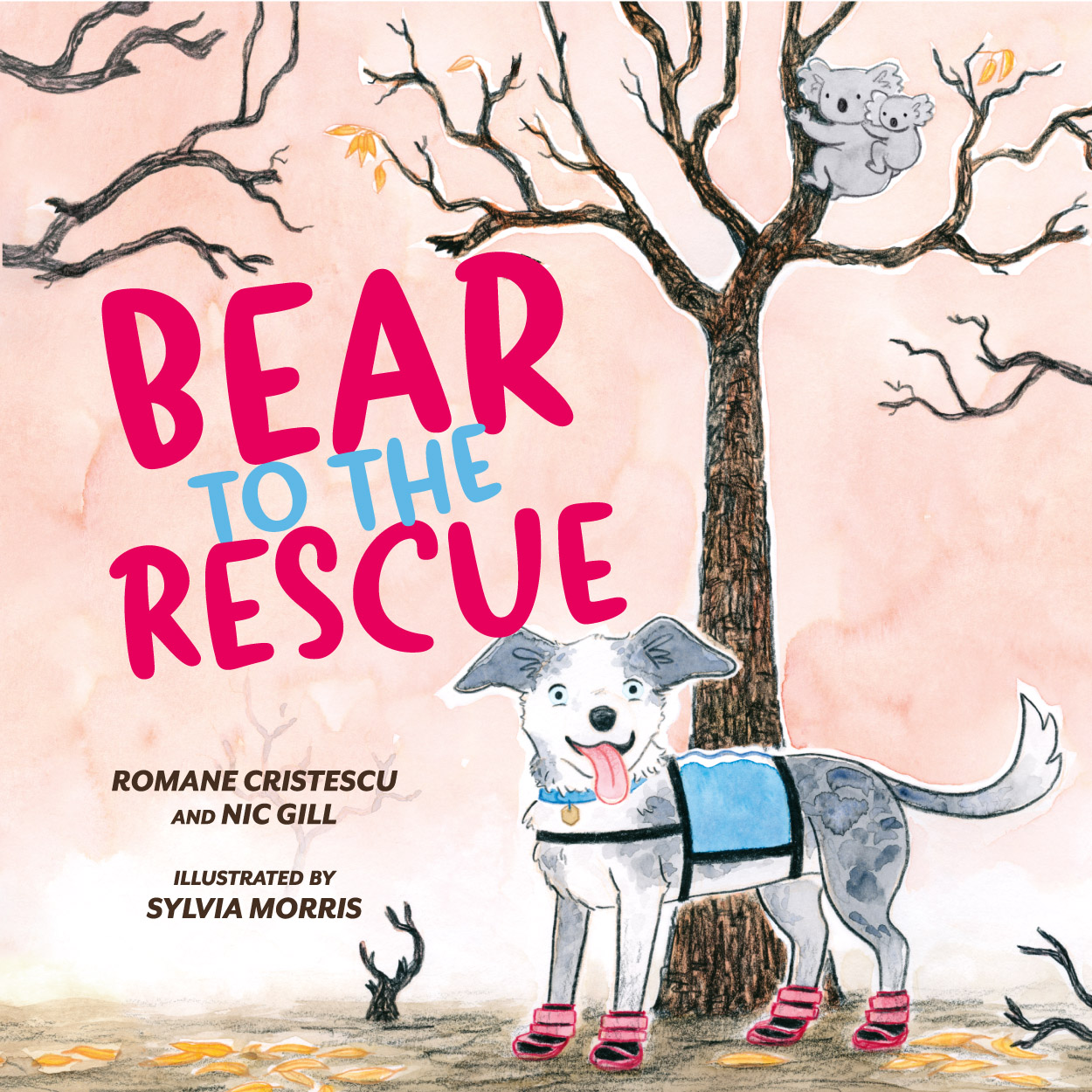 Join us to hear authors Romane Cristescu and Nic Gill read their new book Bear to the Rescue – with a special guest appearance from Bear himself! Inspired by a true story, Bear to the Rescue follows Bear, a high-energy dog who never seems to fit in. Full of enthusiasm and always on the go, Bear is often told he's "too much" – until he discovers a job that is just right for him.