
Some of the most complex processes in materials and biological systems happen at the scale of atoms and molecules, making them difficult to study directly.
PhD students Leyda Juliana Rivera Contreras and Callum Macfarlane are approaching this challenge from different directions through the CSIRO Next Generation Graduates Program. Juliana works with quantum devices designed to directly mimic materials, while Callum develops computer models of how molecules move and behave.
Building a quantum twin
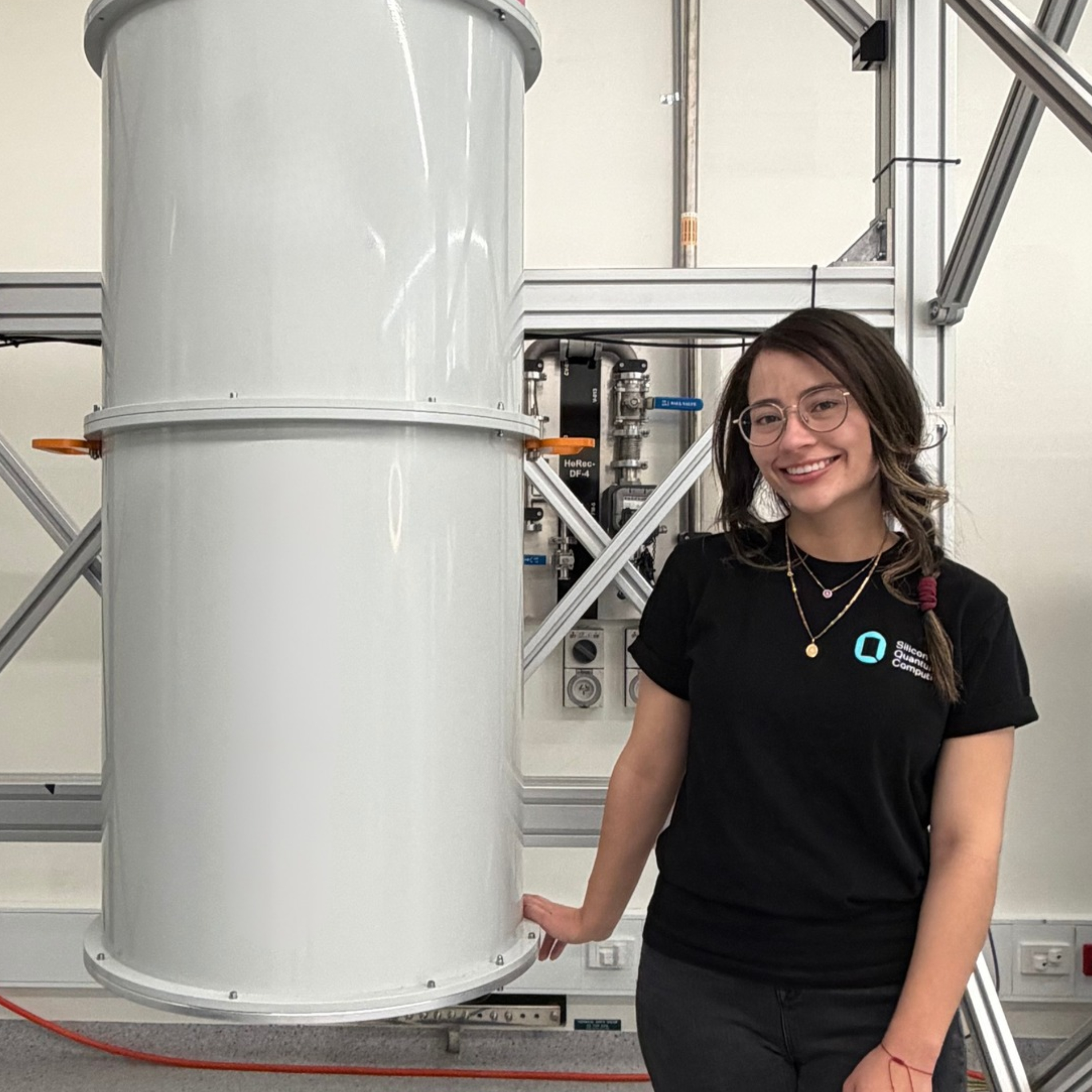 Juliana is a second-year Physics PhD student at UNSW, working with Silicon Quantum Computing (SQC). Her research focuses on analogue quantum simulation.
“In simple words, the idea behind analogue quantum simulation is to build chips that copy real materials, so we can study them,” Juliana said.
SQC’s simulator chips contain large arrays of phosphorus atoms placed in silicon with 0.13 nanometre accuracy. This precision enables SQC to create custom chips, that physically encode direct replicas of the materials and chemical interactions that researchers wish to analyse and understand.
This makes it possible to investigate strongly interacting quantum systems that are too complex for classical computer to model at scale. In the longer term, these systems could pave the way to a better understanding of advanced materials, including high-temperature superconductors, which are being explored for applications such as more efficient power transmission.
Juliana’s project has two parts. The first explores a new device design to further reduce electrical noise caused by charges near the phosphorus array, which can make the device’s signals harder to interpret. Juliana is testing whether metal layers placed above and below the array can provide even greater control over the device.
A later part of her project will explore different atomic arrangements. Changing the pattern of the atoms changes how the electrons behave, allowing researchers to replicate different materials and investigate their properties. Juliana is particularly interested in hexagonal lattices like those found in graphene, a material with potential applications in low-power electronics.
Her immediate focus is preparing her first device using what she describes as a “metal sandwich design”. The device will be measured in a dilution refrigerator, which allows researchers to test it at extremely low temperatures.
“I am really looking forward to taking it to the cleanroom, measuring it in the fridge, and seeing if the noise goes down,” she said. “Hopefully, that will help us see some interesting physics.”
Her co-supervisor at SQC, Dr Matthew Donnelly, said she had drawn on her experience in cleanroom processing and quantum devices to “make significant contributions to SQC’s quantum simulation technology”.
Juliana’s path to this work began in a small town in Colombia. “I never felt like the smartest person in my physics classes, but I was always passionate about using physics to do something useful,” she said. Internships in the United States, Canada and then Australia eventually led her to her PhD.
Improving the virtual lab
At the University of Queensland, third-year PhD student Callum Macfarlane studies molecular dynamics, the computer simulation of how molecules move and behave. His research looks at ways to better represent molecular behaviour and quantum effects in biological systems, with applications including molecular simulation and drug design.
Instead of observing chemistry in a wet lab, researchers can simulate processes on a supercomputer. This allows them to examine atomic-scale movement in detail, including how a potential drug moves and binds to a protein.
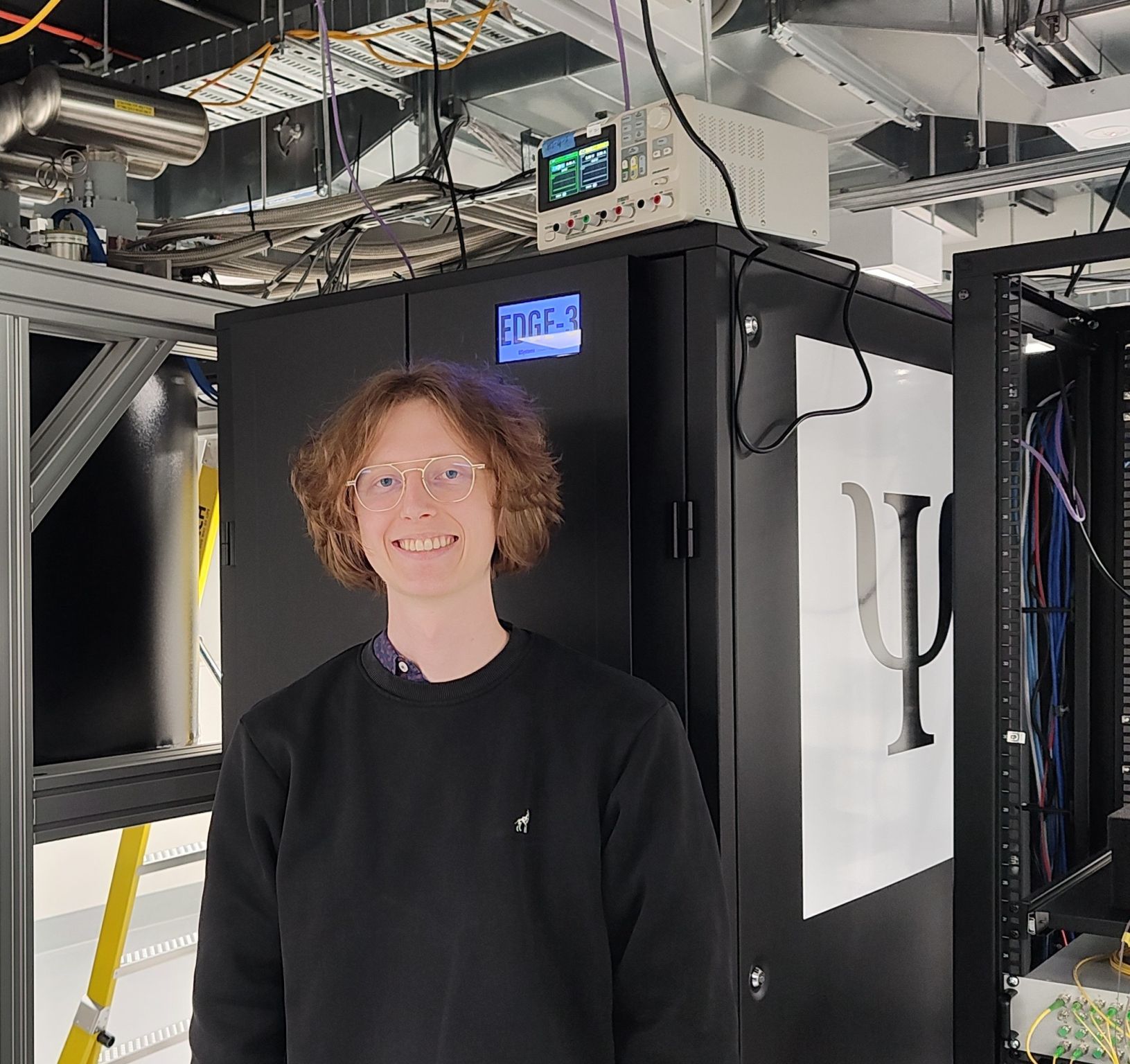 “A simulation is a model, so it isn’t the same as doing an experiment,” Callum explained. “But you can watch the atomic-level structures move around and make a 3D video of how a drug is binding to a protein, which you cannot do in real life.”
Callum develops methods to make these simulations more accurate, particularly in how they represent electrical forces within and between molecules. Getting these forces right can be important when predicting whether a drug will bind successfully to its target.
Many methods in use today have strong roots in research from the 1980s and 1990s, when researchers lacked the computing power and data needed to pursue more computationally demanding approaches. Callum is revisiting some of those ideas with modern supercomputers, which can run thousands of calculations in a day.
His early results indicate that using more information can improve how closely simulations agree with experiments.
“The rewarding part is that it seems to be working,” he said. Research can involve weeks of repeated calculations, and finding a small software error can mean running them all again. Seeing the results improve makes that effort worthwhile.
Quantum physics shapes his work in two ways. He uses quantum-mechanical calculations to determine the electrical properties of molecules, which then feed into his simulations. Looking further ahead, quantum computing could potentially support some of the most computationally demanding parts of molecular simulation. Callum expects early applications to use quantum computing for the most demanding calculations and conventional methods for the rest.
Molecular dynamics is already one of the computational tools used in drug discovery, alongside approaches such as machine learning and lab testing. As these simulations become more accurate, Callum hopes they could help researchers identify promising medicines with greater confidence before moving to further testing.
Taking research into industry
Callum recently completed a three-month placement with PsiQuantum, working across software engineering and computational chemistry. The placement also showed Callum how many of the skills developed during his PhD could translate to industry.
“I didn’t feel like I was a trainee,” he said. “There was an expectation that I had the background to be able to complete the work on my own.”
A highlight was seeing PsiQuantum’s Test & Validation Lab at Griffith University. Callum said the placement gave him an opportunity to learn new skills and see what it takes to prepare for a working quantum computer.
“Building a utility-scale quantum computer in Brisbane means building a workforce to match. Internships are one of the most direct ways to grow the skills this industry needs right here at home,” said Professor Geoff Pryde, Chief Technical Director at PsiQuantum, who worked alongside Callum during the placement.
The experience also reinforced his interest in a career combining mathematics and science. Callum completed a dual degree in mathematics and biophysics and worked in data science before returning to research for the deeper technical training needed for the roles he wanted.
Both projects show how simulation can give researchers another way to investigate processes at the atomic and molecular scale, whether by replicating a material in a physical device or improving the models used to study molecules on a computer.
Some of the most complex processes in materials and biological systems happen at the scale of atoms and molecules, making them difficult to study directly.
PhD students Leyda Juliana Rivera Contreras and Callum Macfarlane are approaching this challenge from different directions through the CSIRO Next Generation Graduates Program. Juliana works with quantum devices designed to directly mimic materials, while Callum develops computer models of how molecules move and behave.
Building a quantum twin
Juliana is a second-year Physics PhD student at UNSW, working with Silicon Quantum Computing (SQC). Her research focuses on analogue quantum simulation.
“In simple words, the idea behind analogue quantum simulation is to build chips that copy real materials, so we can study them,” Juliana said.
SQC’s simulator chips contain large arrays of phosphorus atoms placed in silicon with 0.13 nanometre accuracy. This precision enables SQC to create custom chips, that physically encode direct replicas of the materials and chemical interactions that researchers wish to analyse and understand.
This makes it possible to investigate strongly interacting quantum systems that are too complex for classical computer to model at scale. In the longer term, these systems could pave the way to a better understanding of advanced materials, including high-temperature superconductors, which are being explored for applications such as more efficient power transmission.
Juliana’s project has two parts. The first explores a new device design to further reduce electrical noise caused by charges near the phosphorus array, which can make the device’s signals harder to interpret. Juliana is testing whether metal layers placed above and below the array can provide even greater control over the device.
A later part of her project will explore different atomic arrangements. Changing the pattern of the atoms changes how the electrons behave, allowing researchers to replicate different materials and investigate their properties. Juliana is particularly interested in hexagonal lattices like those found in graphene, a material with potential applications in low-power electronics.
Her immediate focus is preparing her first device using what she describes as a “metal sandwich design”. The device will be measured in a dilution refrigerator, which allows researchers to test it at extremely low temperatures.
“I am really looking forward to taking it to the cleanroom, measuring it in the fridge, and seeing if the noise goes down,” she said. “Hopefully, that will help us see some interesting physics.”
Her co-supervisor at SQC, Dr Matthew Donnelly, said she had drawn on her experience in cleanroom processing and quantum devices to “make significant contributions to SQC’s quantum simulation technology”.
Juliana’s path to this work began in a small town in Colombia. “I never felt like the smartest person in my physics classes, but I was always passionate about using physics to do something useful,” she said. Internships in the United States, Canada and then Australia eventually led her to her PhD.
Improving the virtual lab
At the University of Queensland, third-year PhD student Callum Macfarlane studies molecular dynamics, the computer simulation of how molecules move and behave. His research looks at ways to better represent molecular behaviour and quantum effects in biological systems, with applications including molecular simulation and drug design.
Instead of observing chemistry in a wet lab, researchers can simulate processes on a supercomputer. This allows them to examine atomic-scale movement in detail, including how a potential drug moves and binds to a protein.
“A simulation is a model, so it isn’t the same as doing an experiment,” Callum explained. “But you can watch the atomic-level structures move around and make a 3D video of how a drug is binding to a protein, which you cannot do in real life.”
Callum develops methods to make these simulations more accurate, particularly in how they represent electrical forces within and between molecules. Getting these forces right can be important when predicting whether a drug will bind successfully to its target.
Many methods in use today have strong roots in research from the 1980s and 1990s, when researchers lacked the computing power and data needed to pursue more computationally demanding approaches. Callum is revisiting some of those ideas with modern supercomputers, which can run thousands of calculations in a day.
His early results indicate that using more information can improve how closely simulations agree with experiments.
“The rewarding part is that it seems to be working,” he said. Research can involve weeks of repeated calculations, and finding a small software error can mean running them all again. Seeing the results improve makes that effort worthwhile.
Quantum physics shapes his work in two ways. He uses quantum-mechanical calculations to determine the electrical properties of molecules, which then feed into his simulations. Looking further ahead, quantum computing could potentially support some of the most computationally demanding parts of molecular simulation. Callum expects early applications to use quantum computing for the most demanding calculations and conventional methods for the rest.
Molecular dynamics is already one of the computational tools used in drug discovery, alongside approaches such as machine learning and lab testing. As these simulations become more accurate, Callum hopes they could help researchers identify promising medicines with greater confidence before moving to further testing.
Taking research into industry
Callum recently completed a three-month placement with PsiQuantum, working across software engineering and computational chemistry. The placement also showed Callum how many of the skills developed during his PhD could translate to industry.
“I didn’t feel like I was a trainee,” he said. “There was an expectation that I had the background to be able to complete the work on my own.”
A highlight was seeing PsiQuantum’s Test & Validation Lab at Griffith University. Callum said the placement gave him an opportunity to learn new skills and see what it takes to prepare for a working quantum computer.
“Building a utility-scale quantum computer in Brisbane means building a workforce to match. Internships are one of the most direct ways to grow the skills this industry needs right here at home,” said Professor Geoff Pryde, Chief Technical Director at PsiQuantum, who worked alongside Callum during the placement.
The experience also reinforced his interest in a career combining mathematics and science. Callum completed a dual degree in mathematics and biophysics and worked in data science before returning to research for the deeper technical training needed for the roles he wanted.
Both projects show how simulation can give researchers another way to investigate processes at the atomic and molecular scale, whether by replicating a material in a physical device or improving the models used to study molecules on a computer.