
With Brisbane 2032 approaching, Australia needs more experts who can turn complex sports data into practical insights. Data can help strengthen talent identification, optimise performance, prevent injury and support athlete wellbeing, but only when sporting organisations have the skills to manage and analyse it responsibly.
Part of CSIRO’s Next Generation Graduates Program (NGGP), the Sports Data Science and AI Consortium brings researchers and industry partners together to train multidisciplinary data scientists across high performance sport and para sport.
"The goal is to develop tools that synthesise insight from the noise in complex systems," said QUT Associate Professor Paul Wu, the consortium’s Chief Investigator. "That gives us quantified evidence to support decisions and designs with athletes, coaches, sports scientists and others."
PhD candidates Liam Heng and Tiri Pestrivas show the breadth of that mission: Liam is examining how data can support national football team selection, while Tiri is applying statistical modelling and AI to wind tunnel data to improve athlete aerodynamics and performance. Together, they explore two connected questions: who should compete, and how can they perform at their best?
Finding the right team
A football fan with a background in mathematics and computer science, Liam is completing a PhD in statistics at UNSW. In partnership with Football Australia, he is developing methods that use player data to inform player evaluation and selection processes.
 Football organisations collect large volumes of data, but much of the analysis is used to understand what has already happened. Liam’s project asks how that information could also guide upcoming selection decisions.
“Currently, the data we are working with is mainly used for retrospective action, but we want to use it proactively,” Liam said.
In practice, that means supporting decisions throughout the selection process. Choosing a national team involves much more than naming the starting 11. Selectors narrow a broad pool of players into a preliminary squad, then a tournament squad and, finally, the team that takes the field.
Liam’s current work focuses on player profiling. He is developing meaningful ways to describe a player’s strengths, assess their suitability for a particular role and understand how they might fit with other players. This is especially challenging in football, where performance depends on individual ability, position, tactics and interactions between teammates.
“You might just think, ‘Pick the best players,’ or ‘Pick the players who work well together,’” Liam said. “But quantifying all of that is a real challenge. There are a lot more steps than you might expect.”
There are few established frameworks that Liam can readily adapt. Clubs and national teams rarely share their selection methods, so Liam’s research, undertaken in collaboration with Football Australia, explores approaches suited to the Australian context.
Working alongside Football Australia’s data team keeps the research connected to real selection challenges. It gives Liam insight into how decisions are made and how his academic ideas could be applied in practice.
The aim is not to replace coaches and scouts, but to give them another source of evidence, helping validate their assessments or explain why the data and the expert eye sometimes point to different conclusions.
While Liam’s research focuses on who should take the field, Tiri Pestrivas is investigating how data can help elite athletes make the most of their performance.
Every second counts
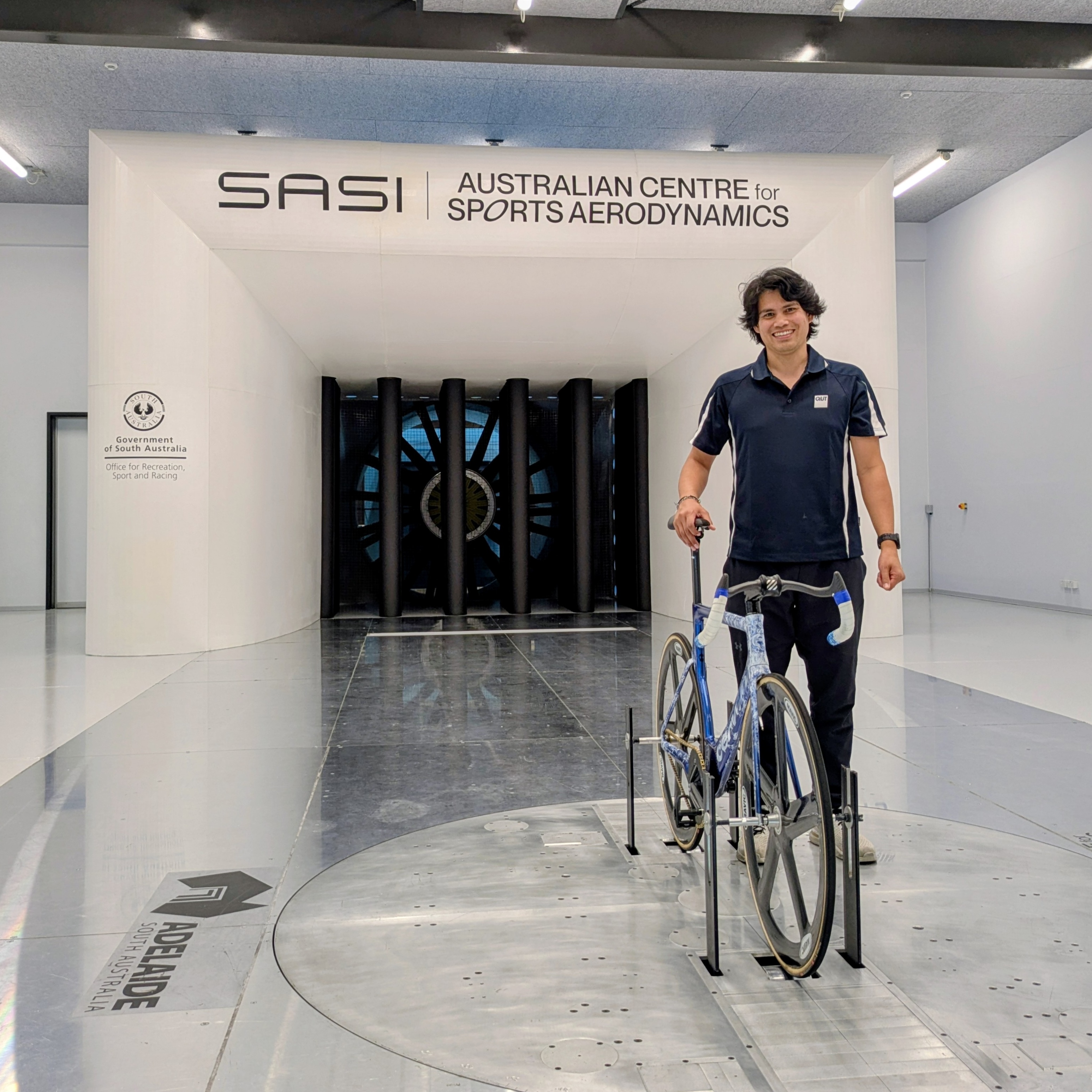 After almost a decade as a mechanical engineer, Tiri moved into sports research through a PhD at QUT, partnered with the South Australian Sports Institute (SASI). His PhD includes being embedded at the Australian Centre for Sports Aerodynamics (ACSA) in Adelaide, giving him practical access to aerodynamic testing and data from simulations and field trials. He also gains hands-on experience by helping to operate the wind tunnel when athletes come in for testing.
That experience brings him close to sport at its highest level. “We have Olympic-level athletes, professional athletes and world champions coming in,” Tiri said.
The facility allows athletes to test how air moves around their bodies and equipment. In high-speed sports such as cycling, skiing and wheelchair racing, reducing aerodynamic drag can help an athlete travel faster without using additional energy.
Each test can produce thousands of measurements, but conventional analysis may condense all that information into a single average. While the average provides a useful overall result, it can conceal changes and patterns within the test. Tiri is exploring whether machine learning and advanced statistical methods can reveal more of those details.
"Despite all the incredible advancement in how we measure, the way the field analyses that data is still quite conventional," he said. "There is a huge opportunity to get more information out of the really rich data being collected."
Those insights can guide practical decisions, for example, helping a cyclist identify which skinsuit works best for their individual body shape and racing conditions.
Tiri sees particularly strong potential in wheelchair racing. Para sports have historically received less investment in aerodynamic research than established sports such as cycling, so testing may uncover larger opportunities to improve an athlete’s position, equipment or racing setup.
Research developed with industry
Liam and Tiri are not developing their ideas in isolation. Liam works alongside Football Australia’s data team, testing how his methods align with the needs of coaches and analysts. Being embedded at ACSA, Tiri can see how aerodynamic evidence is collected and applied in an elite sporting environment.
“This is not industry inspired research with translation at the end,” Paul said. “It is industry collaborative research, with uptake, feedback and co-development throughout the journey.”
As Australia prepares for 2032, these partnerships are developing practical tools and people capable of applying them. From national team selection to aerodynamic performance, Liam and Tiri’s research shows how data science can contribute to Australia’s sporting future.
With Brisbane 2032 approaching, Australia needs more experts who can turn complex sports data into practical insights. Data can help strengthen talent identification, optimise performance, prevent injury and support athlete wellbeing, but only when sporting organisations have the skills to manage and analyse it responsibly.
Part of CSIRO’s Next Generation Graduates Program (NGGP), the Sports Data Science and AI Consortium brings researchers and industry partners together to train multidisciplinary data scientists across high performance sport and para sport.
"The goal is to develop tools that synthesise insight from the noise in complex systems," said QUT Associate Professor Paul Wu, the consortium’s Chief Investigator. "That gives us quantified evidence to support decisions and designs with athletes, coaches, sports scientists and others."
PhD candidates Liam Heng and Tiri Pestrivas show the breadth of that mission: Liam is examining how data can support national football team selection, while Tiri is applying statistical modelling and AI to wind tunnel data to improve athlete aerodynamics and performance. Together, they explore two connected questions: who should compete, and how can they perform at their best?
Finding the right team
A football fan with a background in mathematics and computer science, Liam is completing a PhD in statistics at UNSW. In partnership with Football Australia, he is developing methods that use player data to inform player evaluation and selection processes.
Football organisations collect large volumes of data, but much of the analysis is used to understand what has already happened. Liam’s project asks how that information could also guide upcoming selection decisions.
“Currently, the data we are working with is mainly used for retrospective action, but we want to use it proactively,” Liam said.
In practice, that means supporting decisions throughout the selection process. Choosing a national team involves much more than naming the starting 11. Selectors narrow a broad pool of players into a preliminary squad, then a tournament squad and, finally, the team that takes the field.
Liam’s current work focuses on player profiling. He is developing meaningful ways to describe a player’s strengths, assess their suitability for a particular role and understand how they might fit with other players. This is especially challenging in football, where performance depends on individual ability, position, tactics and interactions between teammates.
“You might just think, ‘Pick the best players,’ or ‘Pick the players who work well together,’” Liam said. “But quantifying all of that is a real challenge. There are a lot more steps than you might expect.”
There are few established frameworks that Liam can readily adapt. Clubs and national teams rarely share their selection methods, so Liam’s research, undertaken in collaboration with Football Australia, explores approaches suited to the Australian context.
Working alongside Football Australia’s data team keeps the research connected to real selection challenges. It gives Liam insight into how decisions are made and how his academic ideas could be applied in practice.
The aim is not to replace coaches and scouts, but to give them another source of evidence, helping validate their assessments or explain why the data and the expert eye sometimes point to different conclusions.
While Liam’s research focuses on who should take the field, Tiri Pestrivas is investigating how data can help elite athletes make the most of their performance.
Every second counts
After almost a decade as a mechanical engineer, Tiri moved into sports research through a PhD at QUT, partnered with the South Australian Sports Institute (SASI). His PhD includes being embedded at the Australian Centre for Sports Aerodynamics (ACSA) in Adelaide, giving him practical access to aerodynamic testing and data from simulations and field trials. He also gains hands-on experience by helping to operate the wind tunnel when athletes come in for testing.
That experience brings him close to sport at its highest level. “We have Olympic-level athletes, professional athletes and world champions coming in,” Tiri said.
The facility allows athletes to test how air moves around their bodies and equipment. In high-speed sports such as cycling, skiing and wheelchair racing, reducing aerodynamic drag can help an athlete travel faster without using additional energy.
Each test can produce thousands of measurements, but conventional analysis may condense all that information into a single average. While the average provides a useful overall result, it can conceal changes and patterns within the test. Tiri is exploring whether machine learning and advanced statistical methods can reveal more of those details.
"Despite all the incredible advancement in how we measure, the way the field analyses that data is still quite conventional," he said. "There is a huge opportunity to get more information out of the really rich data being collected."
Those insights can guide practical decisions, for example, helping a cyclist identify which skinsuit works best for their individual body shape and racing conditions.
Tiri sees particularly strong potential in wheelchair racing. Para sports have historically received less investment in aerodynamic research than established sports such as cycling, so testing may uncover larger opportunities to improve an athlete’s position, equipment or racing setup.
Research developed with industry
Liam and Tiri are not developing their ideas in isolation. Liam works alongside Football Australia’s data team, testing how his methods align with the needs of coaches and analysts. Being embedded at ACSA, Tiri can see how aerodynamic evidence is collected and applied in an elite sporting environment.
“This is not industry inspired research with translation at the end,” Paul said. “It is industry collaborative research, with uptake, feedback and co-development throughout the journey.”
As Australia prepares for 2032, these partnerships are developing practical tools and people capable of applying them. From national team selection to aerodynamic performance, Liam and Tiri’s research shows how data science can contribute to Australia’s sporting future.