
 Artificial intelligence is changing how science is done. It can help researchers search complex knowledge spaces, design experiments, automate repetitive tasks, analyse large datasets and generate new hypotheses. But in science, speed is not enough. AI-enabled research also needs trust, provenance, reproducibility, security and clear connection to real scientific outcomes.
This is where Science Digital comes in. Science Digital is CSIRO’s program for building Sciansa, an AI-for-science platform and community that helps researchers interact with a trusted AI operating environment, digital workflows and scientific automation safely and effectively. Sciansa is designed by scientists, engineers, product specialists and responsible AI experts for use in real research settings, where data, methods, evidence and decisions matter.
Sciansa is now moving from platform development into operational scientific capability. A stable product environment has been built, with domain-specific genomics and biotechnology functionality, AI-assisted research tools, document upload and context features, workflow support, evaluation services and a growing set of scientific agents.
The next phase is focused on expanding adoption, strengthening governance, trust and assurance, and working with external partners to apply Sciansa to research challenges where high-trust AI can create measurable value.
The challenge: turning AI potential into trusted science
AI has already delivered major advances for research, including tools for protein structure prediction, image recognition, language understanding, optimisation and automated analysis. Generative AI and agentic systems now make it possible to imagine a new kind of scientific infrastructure: one where researchers can combine models, data, tools, simulations, robotic systems and domain knowledge in more powerful and accessible ways.
Researchers want the speed and flexibility of AI agents and modern computational tools, but institutions must also manage sensitive data, intellectual property, cost, quality, provenance and reproducibility. Generic AI workbenches can be useful, but they are not usually designed around the requirements of high-stakes scientific workflows, regulated R&D or grounded in deep disciplinary science knowledge and experimentation.
Science Digital is addressing this gap by building Sciansa as more than another AI interface. It is a governed scientific execution and assurance layer: a place where researchers can use AI-enabled tools while retaining traceability of inputs, models, actions and outputs. This is important because it helps shift AI in science from isolated experiments to accountable, reusable and scalable capability.
The solution: AI for science, with trust built in
Sciansa's enduring value is in providing the trusted operational layer that allows research organisations to safely and effectively use AI. Sciansa connects researchers, AI models, scientific tools, workflows, robotics and institutional governance into one reproducible operating environment.
Sciansa enables scientists to build, run and combine AI-assisted workflows in a secure and increasingly governed environment. The platform brings together a user-facing product experience, scientific agents and tools, workflow execution capability, model access, provenance capture and engineering practices that support reliability and reuse.
Our ongoing development work is focused on platform runtime and infrastructure, agent behaviour and orchestration, biotechnology and robotics workflow implementation, governance and safety, assurance and continuous improvement, and platform enablement and adoption. These developments are making the platform more stable, accountable, useful and easier for researchers to adopt.
A key design principle is to reduce friction for researchers without compromising institutional oversight. Sciansa allows researchers to work through appropriate interfaces, from a web product experience through to approved programmatic access, while governance, provenance, access control and audit remain embedded in the platform. The aim is simple: faster and more impactful science for researchers, trusted AI for institutions.
Sciansa also extends this trusted environment to the physical parts of science, under the same interface. This means supporting connections to sensors and robots in the lab and creating workflows around experiments that can be customised by scientists. This allows researchers to work with digital and physical AI in one place rather than across separate systems. Our approach is to teleoperate to automate: using data-driven policies to control robots, with interfaces that remove people from the physical location, which is sometimes hazardous, in the short term, and lead to automation in the limit. Each teleoperated session is also a demonstration, so the platform gets closer to automation, the more it is used.
What Sciansa has achieved so far
Science Digital has progressed from proof-of-concept development into a working product and scientific capability base. Current achievements include:
- a stable Sciansa product instance with improved user experience, document upload, notes and workflow support;
- a growing suite of AI agents and scientific services, including data-source/RAG capability, evaluation services, genome assembly and protein structure prediction;
- genomics workflows that help researchers move from “doing” computational process work to “using” results for scientific enquiry, discovery and insight;
- robotics and imaging progress through the IRIS insect digitisation workflow, reducing manual handling and producing outputs ready for curator review;
- benchmarking of Sciansa-enabled genomics workflows against quality, reproducibility and usability measures;
- scientific papers demonstrating progress in enzyme design, genome assembly and AI-enabled sequence-to-function prediction;
- adoption growth through CSIRO engagement, Google-funded genomics use case projects, collaboration within CSIRO in areas such as biosecurity, agriculture, and environment, and early external engagements.
Making it real: scientific use cases
Genomics and biotechnology
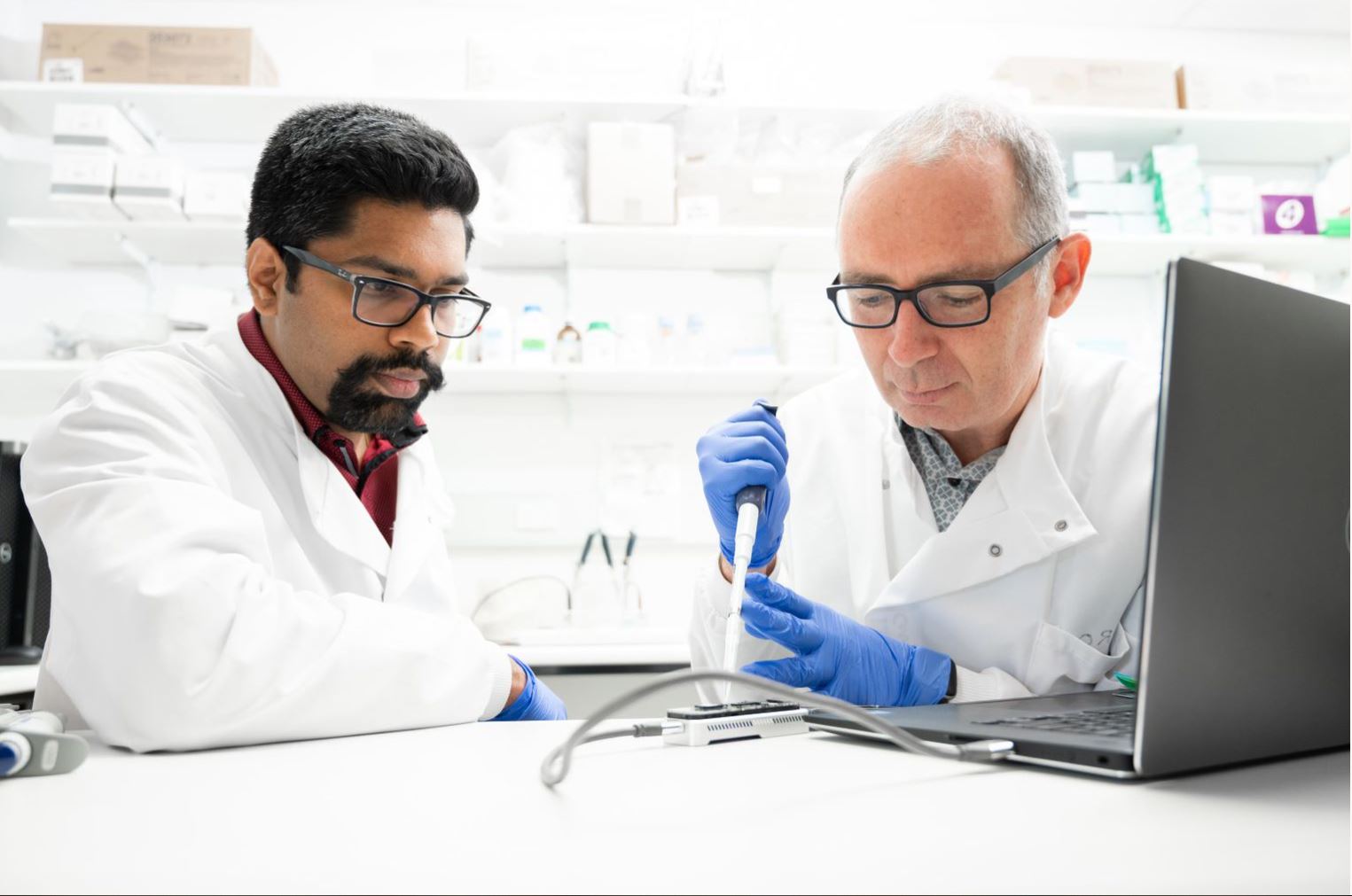 Sequencing is now fast and increasingly affordable, but interpreting what genomes mean remains a major bottleneck. Researchers still spend substantial effort on data processing, workflow setup, tool selection, systems administration and manual interpretation before they can focus on biological insight.
Sciansa is helping address this through genomics and biotechnology workflows that support genome assembly, annotation, protein function prediction, protein structure prediction and genome-scale metabolic modelling. Current and planned tools include established bioinformatics services, machine-learning models and agentic workflows such as GeneWhisperer, Entrez, genome assembly, and AlphaGenome-related evaluation.
This capability is designed to make advanced genomics and biotechnology workflows more accessible to non-specialist scientists while preserving quality and reproducibility. Initial benchmarking has shown that pilot non-genomics specialist users could complete genome assembly workflows unaided, interpret reports and make justified experimental decisions.
Digitisation of national collection and robotics
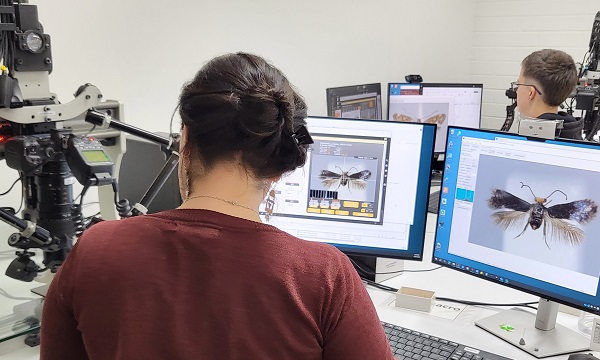 Biological collections are a major scientific resource. They hold evidence of species diversity, environmental change and biological innovation across space and time. But digitising and interpreting collection material is slow, manual and difficult to scale.
Sciansa’s robotics and imaging work is supporting new approaches to digitisation. The IRIS insect imaging workflow captures specimens and labels while reducing manual handling, then produces outputs suitable for curator review. This provides a lower-risk environment for developing AI-assisted robotics, visual reasoning and automation methods that can later support more complex laboratory and autonomous science workflows.
The broader aim is to connect digital science, robotics, imaging, data extraction and reasoning models so that physical scientific work can increasingly be integrated with trusted digital workflows. This opens pathways for autonomous laboratories, high-throughput biodiversity analysis and repeatable AI-assisted experimental systems.
AI trust for contemporary science challenges
The rapid rise of generative AI raises important questions for science: how do we verify outputs, avoid unsafe data use, keep records of AI-assisted work, evaluate agent performance, and make decisions traceable to evidence?
Our current and planned work strengthens privacy-preserving prompts, automated verification, guardrails, secure permissioning, evaluation services, provenance capture, auditability, cost and usage visibility, and project-aware access. These capabilities are important because they support AI-enabled science with confidence that governance and reproducibility are part of the scientific infrastructure, rather than an afterthought.
Our partnerships: accelerating high-trust AI for science
Science Digital works with partners who want to apply AI to real scientific problems and build evidence for trusted, scalable adoption. Google is a strategic partner, supporting use cases that combine Science Digital genomics capability with Google tools and expertise. Current activity includes Google-funded proof-of-concept projects designed to identify and accelerate additional genomics use cases across our research areas.
We are also developing external collaborations where Sciansa can provide value as a trusted platform for AI-enabled research. This includes emerging work in medical research and opportunities in biotechnology, biosecurity, agriculture, environmental science and other domains where AI must be powerful, reliable and governed.
Sciansa is not trying to replace domain scientists, bioinformaticians, roboticists or high-performance computing infrastructure. Instead, it helps connect these capabilities through governed orchestration, reusable workflows, provenance, evaluation and researcher-facing tools that make advanced AI more accessible and more accountable.
Why work with Science Digital?
We combine deep domain science, national research infrastructure, responsible AI expertise, software engineering, product design, robotics, genomics, collections science and partnerships across government, industry and research institutions.
Science Digital is seeking partners who want to build practical, high-trust AI capability for science. We are particularly interested in collaborations that have clear scientific value, strong user need, technical feasibility and potential to deliver impact in research domains.
We can help partners explore how AI agents, scientific workflows, trusted model access, evaluation, provenance and automation can accelerate research while keeping evidence, governance and reproducibility at the centre. Together, we can move AI for science from promising demonstrations to dependable research infrastructure.
Work with us
If you are a research organisation, funder, industry partner or scientific team interested in trusted AI-enabled discovery, we would like to hear from you. Science Digital can help explore opportunities for collaborative projects, domain-specific workflows, AI-assisted genomics and biotechnology, robotics and digitisation, scientific assurance, and responsible AI adoption in research settings.
Artificial intelligence is changing how science is done. It can help researchers search complex knowledge spaces, design experiments, automate repetitive tasks, analyse large datasets and generate new hypotheses. But in science, speed is not enough. AI-enabled research also needs trust, provenance, reproducibility, security and clear connection to real scientific outcomes.
This is where Science Digital comes in. Science Digital is CSIRO’s program for building Sciansa, an AI-for-science platform and community that helps researchers interact with a trusted AI operating environment, digital workflows and scientific automation safely and effectively. Sciansa is designed by scientists, engineers, product specialists and responsible AI experts for use in real research settings, where data, methods, evidence and decisions matter.
Sciansa is now moving from platform development into operational scientific capability. A stable product environment has been built, with domain-specific genomics and biotechnology functionality, AI-assisted research tools, document upload and context features, workflow support, evaluation services and a growing set of scientific agents.
The next phase is focused on expanding adoption, strengthening governance, trust and assurance, and working with external partners to apply Sciansa to research challenges where high-trust AI can create measurable value.
The challenge: turning AI potential into trusted science
AI has already delivered major advances for research, including tools for protein structure prediction, image recognition, language understanding, optimisation and automated analysis. Generative AI and agentic systems now make it possible to imagine a new kind of scientific infrastructure: one where researchers can combine models, data, tools, simulations, robotic systems and domain knowledge in more powerful and accessible ways.
Researchers want the speed and flexibility of AI agents and modern computational tools, but institutions must also manage sensitive data, intellectual property, cost, quality, provenance and reproducibility. Generic AI workbenches can be useful, but they are not usually designed around the requirements of high-stakes scientific workflows, regulated R&D or grounded in deep disciplinary science knowledge and experimentation.
Science Digital is addressing this gap by building Sciansa as more than another AI interface. It is a governed scientific execution and assurance layer: a place where researchers can use AI-enabled tools while retaining traceability of inputs, models, actions and outputs. This is important because it helps shift AI in science from isolated experiments to accountable, reusable and scalable capability.
The solution: AI for science, with trust built in
Sciansa's enduring value is in providing the trusted operational layer that allows research organisations to safely and effectively use AI. Sciansa connects researchers, AI models, scientific tools, workflows, robotics and institutional governance into one reproducible operating environment.
Sciansa enables scientists to build, run and combine AI-assisted workflows in a secure and increasingly governed environment. The platform brings together a user-facing product experience, scientific agents and tools, workflow execution capability, model access, provenance capture and engineering practices that support reliability and reuse.
Our ongoing development work is focused on platform runtime and infrastructure, agent behaviour and orchestration, biotechnology and robotics workflow implementation, governance and safety, assurance and continuous improvement, and platform enablement and adoption. These developments are making the platform more stable, accountable, useful and easier for researchers to adopt.
A key design principle is to reduce friction for researchers without compromising institutional oversight. Sciansa allows researchers to work through appropriate interfaces, from a web product experience through to approved programmatic access, while governance, provenance, access control and audit remain embedded in the platform. The aim is simple: faster and more impactful science for researchers, trusted AI for institutions.
Sciansa also extends this trusted environment to the physical parts of science, under the same interface. This means supporting connections to sensors and robots in the lab and creating workflows around experiments that can be customised by scientists. This allows researchers to work with digital and physical AI in one place rather than across separate systems. Our approach is to teleoperate to automate: using data-driven policies to control robots, with interfaces that remove people from the physical location, which is sometimes hazardous, in the short term, and lead to automation in the limit. Each teleoperated session is also a demonstration, so the platform gets closer to automation, the more it is used.
What Sciansa has achieved so far
Science Digital has progressed from proof-of-concept development into a working product and scientific capability base. Current achievements include:
- a stable Sciansa product instance with improved user experience, document upload, notes and workflow support;
- a growing suite of AI agents and scientific services, including data-source/RAG capability, evaluation services, genome assembly and protein structure prediction;
- genomics workflows that help researchers move from “doing” computational process work to “using” results for scientific enquiry, discovery and insight;
- robotics and imaging progress through the IRIS insect digitisation workflow, reducing manual handling and producing outputs ready for curator review;
- benchmarking of Sciansa-enabled genomics workflows against quality, reproducibility and usability measures;
- scientific papers demonstrating progress in enzyme design, genome assembly and AI-enabled sequence-to-function prediction;
- adoption growth through CSIRO engagement, Google-funded genomics use case projects, collaboration within CSIRO in areas such as biosecurity, agriculture, and environment, and early external engagements.
Making it real: scientific use cases
Genomics and biotechnology
Sequencing is now fast and increasingly affordable, but interpreting what genomes mean remains a major bottleneck. Researchers still spend substantial effort on data processing, workflow setup, tool selection, systems administration and manual interpretation before they can focus on biological insight.
Sciansa is helping address this through genomics and biotechnology workflows that support genome assembly, annotation, protein function prediction, protein structure prediction and genome-scale metabolic modelling. Current and planned tools include established bioinformatics services, machine-learning models and agentic workflows such as GeneWhisperer, Entrez, genome assembly, and AlphaGenome-related evaluation.
This capability is designed to make advanced genomics and biotechnology workflows more accessible to non-specialist scientists while preserving quality and reproducibility. Initial benchmarking has shown that pilot non-genomics specialist users could complete genome assembly workflows unaided, interpret reports and make justified experimental decisions.
Digitisation of national collection and robotics
Biological collections are a major scientific resource. They hold evidence of species diversity, environmental change and biological innovation across space and time. But digitising and interpreting collection material is slow, manual and difficult to scale.
Sciansa’s robotics and imaging work is supporting new approaches to digitisation. The IRIS insect imaging workflow captures specimens and labels while reducing manual handling, then produces outputs suitable for curator review. This provides a lower-risk environment for developing AI-assisted robotics, visual reasoning and automation methods that can later support more complex laboratory and autonomous science workflows.
The broader aim is to connect digital science, robotics, imaging, data extraction and reasoning models so that physical scientific work can increasingly be integrated with trusted digital workflows. This opens pathways for autonomous laboratories, high-throughput biodiversity analysis and repeatable AI-assisted experimental systems.
AI trust for contemporary science challenges
The rapid rise of generative AI raises important questions for science: how do we verify outputs, avoid unsafe data use, keep records of AI-assisted work, evaluate agent performance, and make decisions traceable to evidence?
Our current and planned work strengthens privacy-preserving prompts, automated verification, guardrails, secure permissioning, evaluation services, provenance capture, auditability, cost and usage visibility, and project-aware access. These capabilities are important because they support AI-enabled science with confidence that governance and reproducibility are part of the scientific infrastructure, rather than an afterthought.
Our partnerships: accelerating high-trust AI for science
Science Digital works with partners who want to apply AI to real scientific problems and build evidence for trusted, scalable adoption. Google is a strategic partner, supporting use cases that combine Science Digital genomics capability with Google tools and expertise. Current activity includes Google-funded proof-of-concept projects designed to identify and accelerate additional genomics use cases across our research areas.
We are also developing external collaborations where Sciansa can provide value as a trusted platform for AI-enabled research. This includes emerging work in medical research and opportunities in biotechnology, biosecurity, agriculture, environmental science and other domains where AI must be powerful, reliable and governed.
Sciansa is not trying to replace domain scientists, bioinformaticians, roboticists or high-performance computing infrastructure. Instead, it helps connect these capabilities through governed orchestration, reusable workflows, provenance, evaluation and researcher-facing tools that make advanced AI more accessible and more accountable.
Why work with Science Digital?
We combine deep domain science, national research infrastructure, responsible AI expertise, software engineering, product design, robotics, genomics, collections science and partnerships across government, industry and research institutions.
Science Digital is seeking partners who want to build practical, high-trust AI capability for science. We are particularly interested in collaborations that have clear scientific value, strong user need, technical feasibility and potential to deliver impact in research domains.
We can help partners explore how AI agents, scientific workflows, trusted model access, evaluation, provenance and automation can accelerate research while keeping evidence, governance and reproducibility at the centre. Together, we can move AI for science from promising demonstrations to dependable research infrastructure.
Work with us
If you are a research organisation, funder, industry partner or scientific team interested in trusted AI-enabled discovery, we would like to hear from you. Science Digital can help explore opportunities for collaborative projects, domain-specific workflows, AI-assisted genomics and biotechnology, robotics and digitisation, scientific assurance, and responsible AI adoption in research settings.